Thanks to a footnote in her book, we know that in 1960 the North End had a dwelling unit density of 275 per net acre of residential land, and Roxbury ranged between 21-40, according to planning commission measurements. But how does that compare to today, and to other neighborhoods? And what does it mean, anyway?
Showing posts with label jacobs. Show all posts
Showing posts with label jacobs. Show all posts
Saturday, April 28, 2012
Density per net acre
After this discussion about 'The need for concentration' I found myself wondering about Jacobs method of measuring density in districts. She uses a metric that almost nobody else uses: dwelling or housing units per net residential acre, which counts only land designated for housing. Typical densities are expressed in terms of persons per square mile, counting all types of land. But this can include land that's really devoted to highways, parking lots, institutions, parks, or other places where people do not live. This has a tendency to skew the numbers because most boundaries are drawn to include arbitrary amounts of these non-residential uses. For example, Boston is said to have 12,752 people/sq mile, but residential neighborhoods such as Allston have a density of 18,505 people/sq mile and the North End is listed as nearly 30,000 people/sq mile, or more depending on how you draw the borders.

Wednesday, April 25, 2012
The suburbanization mindset
An all too familiar kind of mind is at work here: a mind seeing only disorder where a most intricate and unique order exists; the same kind of mind that sees only disorder in the life of city streets, and itches to erase it, standardize it, suburbanize it.I've been away for a few days, so I am still catching up on the last week of the City Builder's Book Club. Over the weekend, I came to think more about an offhand comment made by a police officer at a community meeting last week. He came to give a presentation on a few issues relevant to us. One of the last was about the proposed parking lot revamp for one of the stores. I don't know why he was chosen to show this, but he passed around a design sketch from an architect. Parking is always a bit of a contentious issue because there's a lot of people flowing into and around the district, both by car and by foot. Anyway, right at the end, he commented that he "would rather see some of the small storefronts torn down and a big parking garage put in their place." Understandably, I got a bit upset about this, but I let it go since it was just his opinion, and he doesn't decide these things.
Representatives from the police department have also been fairly negative over the years about bringing in liquor licenses and extending restaurant hours. It makes some sense. To them, they see it as stretching their already thin resources. They look at the apparently (relatively) easy jobs in suburban precincts and seek to import that form into the city. I agree that it's perverse that adding liquor licenses to a district doesn't add additional funding for police and emergency services there. It's a function of our obsolete system of licensing, which should be replaced by proper excise taxes that pay for the local services they require. But even without that change, it is clear that the kind of "suburbanization" that the police officer desired, and that Jane Jacobs talks about in the above quote, is not the answer either.
Monday, April 2, 2012
Attrition of automobiles / erosion of cities
 |
| Probably not what Jacobs had in mind (source) |
Jacobs was far ahead of her time in writing that widening and building new roads instigates additional automobile traffic. This is an observation that had only begun to be discussed in the 60s, and people still have difficulty with it today. In 1962, Anthony Downs proposed "the fundamental law of highway congestion" which states that highway travel increases closely in proportion to highway construction. There is also a similar proposition called the Lewis-Mogridge Position. Recent work also explores this relationship in more depth.
Nowadays, responsible engineers and planners (ones not trying to profit from excessive concrete) understand this dilemma and in some places, have actually tried some different ways of fighting traffic that Jacobs would appreciate. But many people get confused when you discuss this issue with them for the first time. It is counterintuitive. Most people have experience driving on a highway that has one lane shutdown for some reason. They see the bottleneck created and exclaim that narrowing the highway permanently could only make things worse!
The confusion lies in the various different perspectives one can take on this problem. Most people are thinking in the immediate situation: the cars on the road are stuck because the highway is suddenly smaller than it was before. But that's not the perspective that road designers and city planners are supposed to take. They are supposed to think about how each road plays into the larger network of transportation, and the even larger world of development and land use, over the course of years. The construction (or removal) of highways and roads causes many people to re-evaluate their patterns of travel, their choices of residence, and how they go about getting around. It is this effect which causes observations like "fundamental law of highway congestion" to come true.
Let's look at an example: Boston's inner belt highway famously has no congestion. That's because Boston's inner belt highway doesn't exist. True, there are roads where the inner belt highway was planned, and they are often congested. But if the highway had been constructed, it too would have become congested in time, much like Rt 128 is today. And its construction would have ravaged a great swathe of land through Roxbury, Fenway/Kenmore, Brookline and Cambridge. In fact, the spot I am typing this from would have been badly affected, possibly destroyed. Thankfully, the residents of the time successfully opposed the highway. The ones that did get built have done a lot of damage, however. After all, we just spent $22 billion to bury one of the most infamous highway projects of all time. And one of the major unintended effects was to create even more congestion at the choke-points entering the city.
Fundamentally, congestion is going to happen around any attractive location, and there's almost nothing you can do about it. Automobile congestion springs up easily because cars are a particularly space-inefficient form of travel. If one person decides not to drive downtown, it is likely that somebody else is waiting to take up that space. And if more space is made available, then more drivers will take advantage of it. That's why public transportation doesn't cure congestion, and it is dishonest to claim it will. What public transportation can do is accommodate greater numbers of people than the roadways will permit. Although the congestion doesn't go away, the absolute number of people able to travel can go up, given appropriate transit options.
Only road pricing seems to have any effect on congestion. This shouldn't be too surprising to anyone who supports free markets, but many people go slightly insane when confronted with their addiction to Road Socialism. If a product is free or underpriced, then the supply becomes exhausted and queues form to obtain it. Most roads are free, or underpriced, so it is only natural that people form queues of traffic trying to use them. When road pricing is done right, it doesn't discourage travelers, it just sets a market incentive to use other modes of transportation when the roads become too busy. Sadly, it seems like it will be quite a long time before this reform is implemented around here, as it requires people to give up what many feel is an entitlement. If people could come to understand that "time is money" and either way, they're going to pay, then perhaps those stubborn impulses can be checked.
Saturday, March 17, 2012
The rent is too damn high
I've finally gotten around to reading The Rent is Too Damn High by Matthew Yglesias and I think it is a fine long form article/e-book. It isn't going to be terribly novel to anyone who has been following these issues for a while, but it does put them together in a pretty coherent and easy form in his characteristic style. For those who don't know his writing, I will say that Yglesias has a knack for putting non-obvious ideas into terms that make you wonder why you didn't think of it that way before. He is not afraid to challenge orthodoxy on both sides of the political spectrum when it comes to cities and urban planning, and that alone makes it worthwhile to pick up and read, even if you do end up disagreeing with some of the specifics.
Since in the continuing series on Death and Life of Great American Cities we just covered the chapter on 'Self-destruction of diversity' I think it is relevant to talk about Yglesias' chapter on 'The Mirage of Gentrification' which is also the part of the e-book that I think is weakest.
He is correct to point out that higher land prices attract developers, and that it is perverse to try and keep prices low through neglect. He is also right to point out that the only way to bring down rents is to build more dwelling units. But I think he dismisses too quickly the problem of disrupting community ties and seems to presume that foes of gentrification are only interested in preserving 'neighborhood character.' It is true that some people do think that way, but there is a more subtle reason to be concerned about rapid changes and it is one that Jane Jacobs dwells upon extensively.
Now, regarding 'character' I'm going to go out on a limb and say "does it really matter?" It's a nice thing, and I certainly have my own preference for more traditional styles while despising Brutalism. But it doesn't ultimately matter (except that Brutalism is soul destroying). What does matter is people, and the relationships between people in the city that Jacobs so eloquently described. As an example: the infamous housing projects of mid-century have many problems. Everyone grimaces when I describe the characteristic Garden City-style towers and super-blocks. And those design choices were certainly bad and deadly to urban well-being. But the worst and most pernicious effect of the housing projects was the way they tore apart neighborhoods and displaced the diversity of people who lived in the old neighborhood, replacing them with a homogeneous economic strata, where people are merely measured by their wages and treated as so many interchangeable pieces.
Cities are about people, first and foremost. The smart opponents of gentrification shouldn't be aiming only to preserve 'character' or the profits of a specific set of business owners, though doing so in moderation is one possible strategy. They really should be trying to preserve the social networks between people that maintain the good workings of the neighborhood. These networks will slowly change over time as people come and go, and the neighborhood will change over time as people build or renovate their properties. But humans can adapt to that naturally. They cannot adapt to having their entire neighborhood be bulldozed and replaced by a centrally planned project. Nor can they adapt well when a developer bulldozes an entire block to build condos, or whatever happens to be the most profitable type of building at that moment in time. Or if rents rise so broadly that some critical number of people are displaced which causes a catastrophic breakdown of the relationships between the former residents.
Of course, as Yglesias points out, having developers build more housing units is the only way to ultimately lower rents. But how do you permit them to build more, and varied units to accommodate diverse lifestyles, while not displacing too many people too quickly? You face the threats of rising rents vs the threat of redevelopment, and the solution to one can exacerbate the other. Unfortunately, it doesn't appear that Yglesias considers the second problem in his analysis, nor does he mention the issue of promoting diversity of use.
In Jacobs' chapter on 'The self-destruction of diversity' she makes some very specific proposals to try and prevent districts from hollowing themselves out: zoning for diversity, staunchness of public buildings, and ultimately increasing the supply of vital city streets to meet demand. By 'zoning for diversity' she means some form of rules which permit change, but not overwhelmingly of one kind, not too quickly. This is fundamentally different from zoning as it is usually practiced, and perhaps makes it a misnomer. The 'staunchness of public buildings' is another form of this same principle, one where the city can simply choose to keep its working properties different from their surroundings by not selling them off. For example, the Massachusetts State House could have been sold for the development of more condos, but its presence keeps an additional kind of primary use around the Boston Common area, to the benefit of all. Admittedly, I find the notion of 'zoning for diversity' to be a tricky one to put into practice. The intention is clearly to help preserve the four properties of successful districts, and the social networks of people who are present there. But it seems liable to be abused in practice, or to be subject to problems of corruption, where a developer could claim they were "preserving diversity" when in effect they were doing the opposite. Yglesias and Jacobs do come together in agreement on the notion that the supply of good, vital city neighborhoods must be increased, somehow.
The main difference between the work of Yglesias and Jacobs can be summarized as thus: Yglesias is interested in increasing intensity of use, but doesn't dwell on the other three characteristics of successful districts. Actually, it is curious that he doesn't mention them at all, since he is clearly aware of her work. However, his basic argument is sound: that land use regulations must be relaxed to permit more free market use of land. This is something that needs to be more widely understood by just about everyone.
Since in the continuing series on Death and Life of Great American Cities we just covered the chapter on 'Self-destruction of diversity' I think it is relevant to talk about Yglesias' chapter on 'The Mirage of Gentrification' which is also the part of the e-book that I think is weakest.
He is correct to point out that higher land prices attract developers, and that it is perverse to try and keep prices low through neglect. He is also right to point out that the only way to bring down rents is to build more dwelling units. But I think he dismisses too quickly the problem of disrupting community ties and seems to presume that foes of gentrification are only interested in preserving 'neighborhood character.' It is true that some people do think that way, but there is a more subtle reason to be concerned about rapid changes and it is one that Jane Jacobs dwells upon extensively.
Now, regarding 'character' I'm going to go out on a limb and say "does it really matter?" It's a nice thing, and I certainly have my own preference for more traditional styles while despising Brutalism. But it doesn't ultimately matter (except that Brutalism is soul destroying). What does matter is people, and the relationships between people in the city that Jacobs so eloquently described. As an example: the infamous housing projects of mid-century have many problems. Everyone grimaces when I describe the characteristic Garden City-style towers and super-blocks. And those design choices were certainly bad and deadly to urban well-being. But the worst and most pernicious effect of the housing projects was the way they tore apart neighborhoods and displaced the diversity of people who lived in the old neighborhood, replacing them with a homogeneous economic strata, where people are merely measured by their wages and treated as so many interchangeable pieces.
Cities are about people, first and foremost. The smart opponents of gentrification shouldn't be aiming only to preserve 'character' or the profits of a specific set of business owners, though doing so in moderation is one possible strategy. They really should be trying to preserve the social networks between people that maintain the good workings of the neighborhood. These networks will slowly change over time as people come and go, and the neighborhood will change over time as people build or renovate their properties. But humans can adapt to that naturally. They cannot adapt to having their entire neighborhood be bulldozed and replaced by a centrally planned project. Nor can they adapt well when a developer bulldozes an entire block to build condos, or whatever happens to be the most profitable type of building at that moment in time. Or if rents rise so broadly that some critical number of people are displaced which causes a catastrophic breakdown of the relationships between the former residents.
Of course, as Yglesias points out, having developers build more housing units is the only way to ultimately lower rents. But how do you permit them to build more, and varied units to accommodate diverse lifestyles, while not displacing too many people too quickly? You face the threats of rising rents vs the threat of redevelopment, and the solution to one can exacerbate the other. Unfortunately, it doesn't appear that Yglesias considers the second problem in his analysis, nor does he mention the issue of promoting diversity of use.
In Jacobs' chapter on 'The self-destruction of diversity' she makes some very specific proposals to try and prevent districts from hollowing themselves out: zoning for diversity, staunchness of public buildings, and ultimately increasing the supply of vital city streets to meet demand. By 'zoning for diversity' she means some form of rules which permit change, but not overwhelmingly of one kind, not too quickly. This is fundamentally different from zoning as it is usually practiced, and perhaps makes it a misnomer. The 'staunchness of public buildings' is another form of this same principle, one where the city can simply choose to keep its working properties different from their surroundings by not selling them off. For example, the Massachusetts State House could have been sold for the development of more condos, but its presence keeps an additional kind of primary use around the Boston Common area, to the benefit of all. Admittedly, I find the notion of 'zoning for diversity' to be a tricky one to put into practice. The intention is clearly to help preserve the four properties of successful districts, and the social networks of people who are present there. But it seems liable to be abused in practice, or to be subject to problems of corruption, where a developer could claim they were "preserving diversity" when in effect they were doing the opposite. Yglesias and Jacobs do come together in agreement on the notion that the supply of good, vital city neighborhoods must be increased, somehow.
The main difference between the work of Yglesias and Jacobs can be summarized as thus: Yglesias is interested in increasing intensity of use, but doesn't dwell on the other three characteristics of successful districts. Actually, it is curious that he doesn't mention them at all, since he is clearly aware of her work. However, his basic argument is sound: that land use regulations must be relaxed to permit more free market use of land. This is something that needs to be more widely understood by just about everyone.
Friday, March 9, 2012
The need for aged buildings
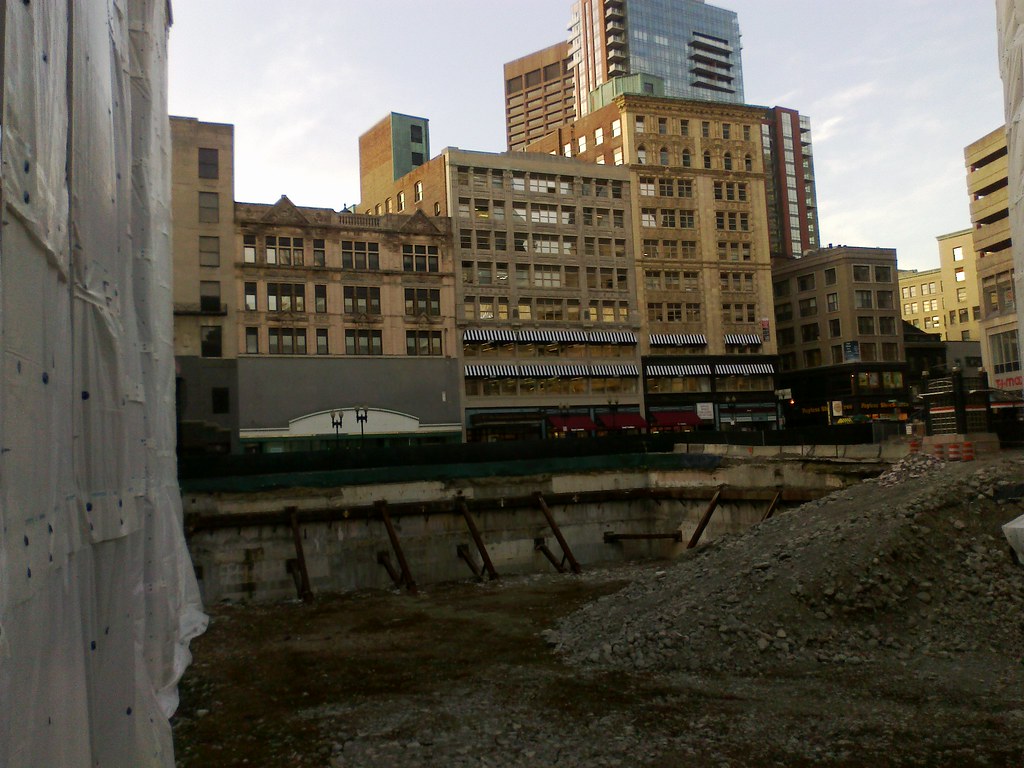 |
| The Filene's "Memorial Hole" in Downtown Crossing |
The economic value of new buildings is replaceable in cities. It is replaceable by the spending of more construction money. But the economic value of old buildings is irreplaceable at will. It is created by time. This economic requisite for diversity is a requisite that vital city neighborhoods can only inherit, and then sustain over the years.I find this chapter of Death and Life to be the most depressing. Not because of its tone or content necessarily, but because of its implication. Three of the four characteristics of successful districts--mixed uses, small blocks, and density--can be encouraged or developed in the short term through thoughtful action, deregulation or planning. But there is only one way to get aged buildings: time.
As for really new ideas of any kind--no matter how ultimately profitable or otherwise successful some of them might prove to be--there is no leeway for such chancy trial, error and experimentation in the high-overhead economy of new construction. Old ideas can sometimes use new buildings. New ideas must use old buildings.
One of the problems afflicting American cities is vast tracts of empty space in otherwise urban areas. Boston is no exception; having flattened many blocks in misguided fits of urban renewal, or for highways and parking lots. When politicians and developers get together and decide to do something about this, they usually produce mega-projects that fill up entire blocks with new construction.
 |
| Part of Assembly Square design |
I can think of several such projects coming up, off the top of my head: Assembly Square, a transit oriented redevelopment of a failed mail in Somerville (more discussion). Fenway Center, which is replacing acres of parking lots and also taking "air rights" over the Mass Pike. There will be new construction in place of the old Boston Herald building. And most infamously, the "Hole" in Downtown Crossing, where a developer decided to play games with the city by knocking down the Filene's building partially and then stop for several years.
All of these projects devote many words in their planning or promotional documents to considering the needs of pedestrians and transit users. It is, after all, the fashion these days. And perhaps they are even sincere, although the amount of parking included in these packages is suspiciously large. Some of the documents carefully sketch out expected flows of people through painstakingly landscaped and architecturally intriguing corridors; replete with ground-level commerce and sidewalk cafes. It all looks quite wonderful on paper. But yet, I can't help but wonder, will these just be sterile failures? Will the promenades be promenaded? What will draw economic activity, and therefore, city vitality? The plans account for density, mixed uses, and to some extent small blocks. But none of them include old buildings, and therefore, none of the economic diversity that can only exist with low overhead.
 |
| Fenway Center rendering |
But surely increasing the amount of commercial and residential space in a city will have beneficial effects overall? Businesses moving out from old buildings into new ones will leave space in old neighborhoods for new businesses. That is, assuming they can entice the existing businesses to give up their established home in favor of a new, unproven location. Some kinds of businesses can and do move around like this, as she does point out, using the example of Brooklyn. But this isn't really helping the diversity of the new neighborhood, just possibly the old ones. On the other hand, some of these new developments are embedded closely with existing city districts. Perhaps that is sufficient, in those cases.
Why does it seem like this dilemma is more difficult in the 21st century compared to the 19th century? For example, it was not uncommon for many cities (including Boston) to lose neighborhoods to out-of-control fires. Yet, they picked up and rebuilt everything, and didn't seem to suffer the same kind of stultifying effects that new development brings today. Perhaps it has to do with the increasing costs of providing modern facilities, up to modern safety standards. Or perhaps the same problem existed back then, but over the years became obscured and forgotten.
Wednesday, February 29, 2012
The need for mixed uses
Downtown, the Pittsburgh Parking Authority's garages are operating at only between 10 and 20 percent of capacity by eight o'clock in the evening, except for the central Mellon Square garage which may reach 50 percent if something is doing at the hotels. (Like parks and consumer shops, parking and traffic facilities are innately inefficient and wasteful without time spread of users.) Meantime, the parking problem three miles from downtown in a section called Oakland is something fierce. "No sooner does one crowd move out of that place than another moves in," explains an Authority official. "It's a headache." It is also easy to understand. Oakland contains the Pittsburgh symphony, the civic light opera, the little-theater group, the most fashionable restaurant, the Pittsburgh Athletic Association, two other major clubs, the main Carnegie library, museum and art galleries, the Historical Society, the Shriners' Mosque, the Mellon Institute, a favorite hotel for parties, the Y.M.H.A., headquarters of the Board of Education, and all the major hospitals.When I first read this paragraph, I was shocked. I had lived in Pittsburgh for a while in the past decade. This description could have been written any time then, or even now. Did Jane Jacobs possess a time machine and decide to write about a city forty or fifty years ahead of her time? Or has Pittsburgh remained fundamentally the same for the past fifty years? I'm going to assume the latter. But why, despite all the talk of improving things for many decades, has it remained the same?
When I lived there, I hardly ever went downtown. After 5pm, all the stores closed. Even the bookstores. Soon, there would be nobody left on the street but some bums. Everyone had retreated back to their neighborhoods. For me, that was East Pittsburgh: Oakland, Shadyside, Squirrel Hill. As far as I was concerned, Oakland was downtown. That's where all the activity centered, around the humongous population of the University of Pittsburgh and also its world famous system of hospitals.
In some ways, Boston has a lot in common with Pittsburgh. In terms of raw population, it's about double the size. Both are constrained geographically by water onto peninsulas, this has shaped the transportation patterns of each. There's a strong sense of neighborhood identity in both. Downtown Boston clears out almost as badly as Pittsburgh -- at least in the Financial district -- although much remains active in the immediate vicinity. Both cities have suffered terribly from a history of segregation, a legacy of which remains to this day. Urban renewal wreaked devastation in both, and yet there still remains some relatively walkable old neighborhoods.
When I read Death and Life and compare the descriptions of Boston and Pittsburgh in the book to my experience of them today, I find myself recognizing the same places and the same problems today that she wrote about fifty years ago. I think that is somewhat depressing. Is it the case that we are unable to address the root causes of the problems in these cities, that they are so similar five decades later? Will I be around five decades hence and looking back, still find that nothing has changed? I hope not.
Friday, February 17, 2012
The Prado and the Greenway

I was walking in the North End this afternoon and I passed through the Paul Revere Mall (a.k.a. the Prado). There was a scattering of people: a family, a couple chatting on a bench, a dog walker, a man playing catch with his son. They were mostly clustered or sitting around the central fountain -- dry now. That brought to mind a similar scene in chapter 5 of Death and Life.
The fountain basin in New York's Washington Square is used inventively and exuberantly. Once, beyond memory, the basin possessed an ornamental iron centerpiece with a fountain. What remains is the sunken concrete circular basin, dry most of the year, bordered with four steps ascending to a stone coping that forms an outer rim a few feet above ground level. In effect, this is a circular arena, a theater in the round, and that is how it is used, with complete confusion as to who are spectators and who are the show.
On my way back, I passed through the relatively new Rose Kennedy Greenway. The part next to Hanover Street is one of the nicer sections. There's a lounging area, a bushy area with paths, some exhibits to peruse. When the weather is really nice, I've seen people sunbathing on the lawn. Today was not that kind of day -- it was warm only in comparison to the usual February weather. Still, there was quite a bit of foot traffic hurrying back and forth between the North End and downtown. But the park itself was otherwise mostly empty.

I decided to walk the long way around to see if I could find anyone enjoying the Greenway in a fashion similar to the Prado. After all, we've committed $22 billion to put the highway underground.

Some open space. It's required by law, in fact. Lots of green grass. Nobody here, though.

Not here either.

Wait, I thought the highway was supposed to be underground.

I finally found a couple of people actually inside of the park. It turned out that they were reading the names on the paving stones.

A jogger. Nearby, there were also some skate-boarders that found a use for all this open space.

Good thing we kicked Occupy Boston out of here. After all, they were preventing all of these people from using this space. Also: what are those things on the ground?

We spent $22 billion dollars for this?

I started to choke from the fumes of the waiting cars. Time to get out of here.

I'm told the Greenway is popular among the officer worker lunchtime crowd. No word on whether the perverts have moved in yet.
Sunday, February 12, 2012
Sidewalks are not like roads
 |
| Beacon Hill |
I have seen a striking difference between presence and absence of casual public trust on two sides of the same wide street in East Harlem, composed of residents of roughly the same incomes and races. On the old-city side, which was full of public places and the sidewalk loitering so deplored by Utopian minders of other people's leisure, the children were being kept well in hand. On the project side of the street across the way, the children, who had a fire hydrant open beside their play area, were behaving destructively, drenching the open windows of houses with water, squirting it on adults who ignorantly walked on the project side of the street, throwing it onto the windows of cars as they went by. Nobody dared to stop them. These were anonymous children, and the identities behind them were an unknown. What if you scolded or stopped them? Who would back you up over there in the blind-eyed Turf? Would you get, instead, revenge? Better to keep out of it.The obvious criticism of such evidence is that they each constitute but a single observation in a vast and varied city. But no dull presentation of statistics is going to illuminate her point like a well chosen anecdote can. She relies on the reader to understand the context. The story about residents who leave their keys at the local delicatessen does not imply that this custom is integral to a lively urban neighborhood. Instead, it shows one instance of the separation between public personae and private life.
One of the mistakes the "Utopian minders" make is to treat sidewalks like roads. That is, they are purely ways to travel, and not destinations in themselves. People don't drive their cars to interact with other people -- and if they do it is likely to be a negative encounter -- rather, they are focused on getting to their destination. Nominally, a sidewalk does have the purpose of letting people walk to places. But when not encased by two tons of metal moving at high speed, people have a tendency to interact with their surroundings. Most people walking are not out to socialize -- they probably do have somewhere to be. But by being in the same place with other people and by moving at normal human speed, they contribute to a self-generating social situation that Jacobs describes as "sidewalk life." When planners gut neighborhoods, when they remove businesses and hide them behind acres of parking, then sidewalk life is strangled because it cuts down on the number of people around for any purpose. It is a self-perpetuating problem: nobody wants to go there because nobody wants to go there. Walkways are not highways for feet.
Nowadays, I think this point is relatively well taken, although not completely understood. Sitting in community meetings I sometimes hear about the plans from developers to create "interesting spaces" or "attractive street-fronts." I think they may be trying too hard. Very few people are going to be attracted to a street just because the buildings are "varied in styles", "have floral planters in front", or an "eye catching design." There seems to be almost a consensus that there is an "architectural solution" to the problem of boring streets. Alternatively, the plans might include a coffee shop or convenience store on the corner, as some kind of outpost of urbanism. I find these to be expressions of a "cargo cult" approach to city planning: imitate the superficial features of successful districts in hopes that the liveliness will come along too.
 |
| San Francisco |
But nevertheless, many of the rich or near-rich in cities appear to appreciate sidewalk life as much as anybody. At any rate, they pay enormous rents to move into areas with an exuberant and varied sidewalk life. They actually crowd out the middle class and the poor in lively areas like Yorkville or Greenwich Village in New York, or Telegraph Hill just off the North Beach streets of San Francisco. They capriciously desert, after only a few decades of fashion at most, the monotonous streets of "quiet residential areas" and leave them to the less fortunate.What's frustrating is that fifty years later, we still haven't figured out how to reliably increase the supply of urban districts with lively sidewalk life, and in many cases, have taken steps to squelch what areas do exist.
Tuesday, February 7, 2012
'A wild kid from the suburbs'
It's week 2 for the reading group and the chapter is 'The uses of sidewalks: safety'. Heather and Steven have already covered some interesting ground on this chapter. While re-reading it, I was struck by one passage in particular:
One night a young man came roaring along, bellowing terrible language at two girls whom he had apparently picked up and who were disappointing him. Doors opened, a wary semicircle formed around him, not too close, until the police came. Out came the heads, too, along Hudson Street, offering opinion, "Drunk ... Crazy ... A wild kid from the suburbs."*
* He turned out to be a wild kid from the suburbs. Sometimes, on Hudson Street, we are tempted to believe the suburbs must be a difficult place to bring up children.Then later, as if on cue, I read this report in the paper:
A 19-year-old Andover [N.H.] man allegedly punctuated the end of a Super Bowl party at the Residences at the Ritz-Carlton in downtown Boston by beating two other men with a pistol, authorities said today.Then and now, this is an common kind of story around Boston, and I would suppose in many other cities. It's only natural for people to come from out of town for 'recreational' purposes. But some blow it out of proportion, and then they end up in the next day's papers.
Wednesday, February 1, 2012
The Death and Life of Great American Cities

The first time I read this book, I originally picked it up from the library along with The Image of the City by Kevin Lynch, a contemporary of Jacobs. I began reading Lynch's book first. Several days later, I happened to open the first page of Death and Life, just to see what it was like. I couldn't put it down. I finished several chapters that afternoon. Her writing style is incredibly compelling and bold. Consider the very first sentence: "This book is an attack on current city planning and rebuilding." She wanted to show people that modern city planning was to science what bloodletting was to medicine. More from the introduction:
There is a wistful myth that if only we had enough money to spend--the figure is usually put at a hundred billion dollars--we could wipe out all our slums in ten years, reverse decay in the great, dull, gray belts that were yesterday's and day-before-yesterday's suburbs, anchor the wandering middle class and its wandering tax money, and perhaps even solve the traffic problem.
But look what we have built with the first several billions: Low-income projects that become worse centers of delinquency, vandalism and general social hopelessness than the slums they were supposed to replace. Middle-income housing projects which are truly marvels of dullness and regimentation, sealed against any buoyancy or vitality of city life. Luxury housing projects that mitigate their inanity, or try to, with a vapid vulgarity. Cultural centers that are unable to support a good bookstore. Civic centers that are avoided by everyone but bums, who have fewer choices of loitering places than others. Commercial centers that are lackluster imitations of standardized suburban chain-store shopping. Promenades that go from no place to nowhere and have no promenaders. Expressways that eviscerate great cities. This is not the rebuilding of cities. This is the sacking of cities.
 |
| Boston's West End, July 1958 (source) |
 |
| The West End, demolished, by September 1960 (source) |
The introduction also covers the sources of various influences in city planning, from the Garden City visions of Ebenezer Howard to the Radiant City Utopian monstrosity of Le Corbusier. Reading her descriptions of their ideas, I began to realize just how far they had penetrated into our society. Cities designed to look pretty from an airplane. Massive highway projects cutting through neighborhoods. High-rise residential towers with humongous parking lots. A fanatical devotion to the notion of "open space" at all costs, and grass everywhere. Separation of uses: residential here, commercial over there. Free parking as a birthright. You can trace much of this kind of thinking back to some authors from the 19th and early 20th century. A reaction against the problems of cities, especially back then, when health and sanitation were minimal. Their solutions were designed, regardless of intention, to destroy cities. To fix the problems of cities by ripping them apart and re-creating them according to some kind of orderly and sterile vision. That these ideas became the foundation of the field of city planning is a scandalous shame.
Jacobs introduced this background to contrast their approach with hers. She was not interested in an ideology which dictated the right answers. She wanted to learn the principles behind successful cities, and the failures of others, through observation and investigation of the reality of cities. As she wrote:
I hope any reader of this book will constantly and skeptically test what I say against his own knowledge of cities and their behavior. If I have been inaccurate in observations or mistaken in inferences and conclusions, I hope these faults will be quickly corrected.
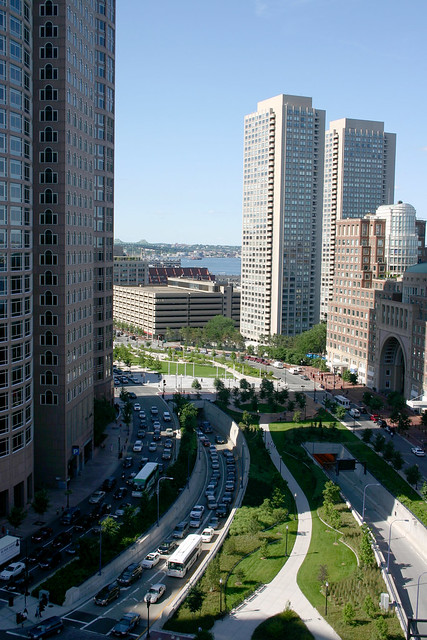 |
| Skyscrapers, open space, and highways (source) |
Many people do not want to have to think about issues of urban planning. They just want to get on with their lives and leave planning to the experts. But Jane Jacobs exposes the so-called experts as charlatans, with little useful knowledge, and a hideous history of malpractice behind them. Instead she implores readers to look for themselves, and "also listen, linger and think about what you see." As people, we live in cities, and are economically dependent upon cities. We cannot escape their importance, and so it behooves us to pay attention to their vitality.
Subscribe to:
Posts (Atom)