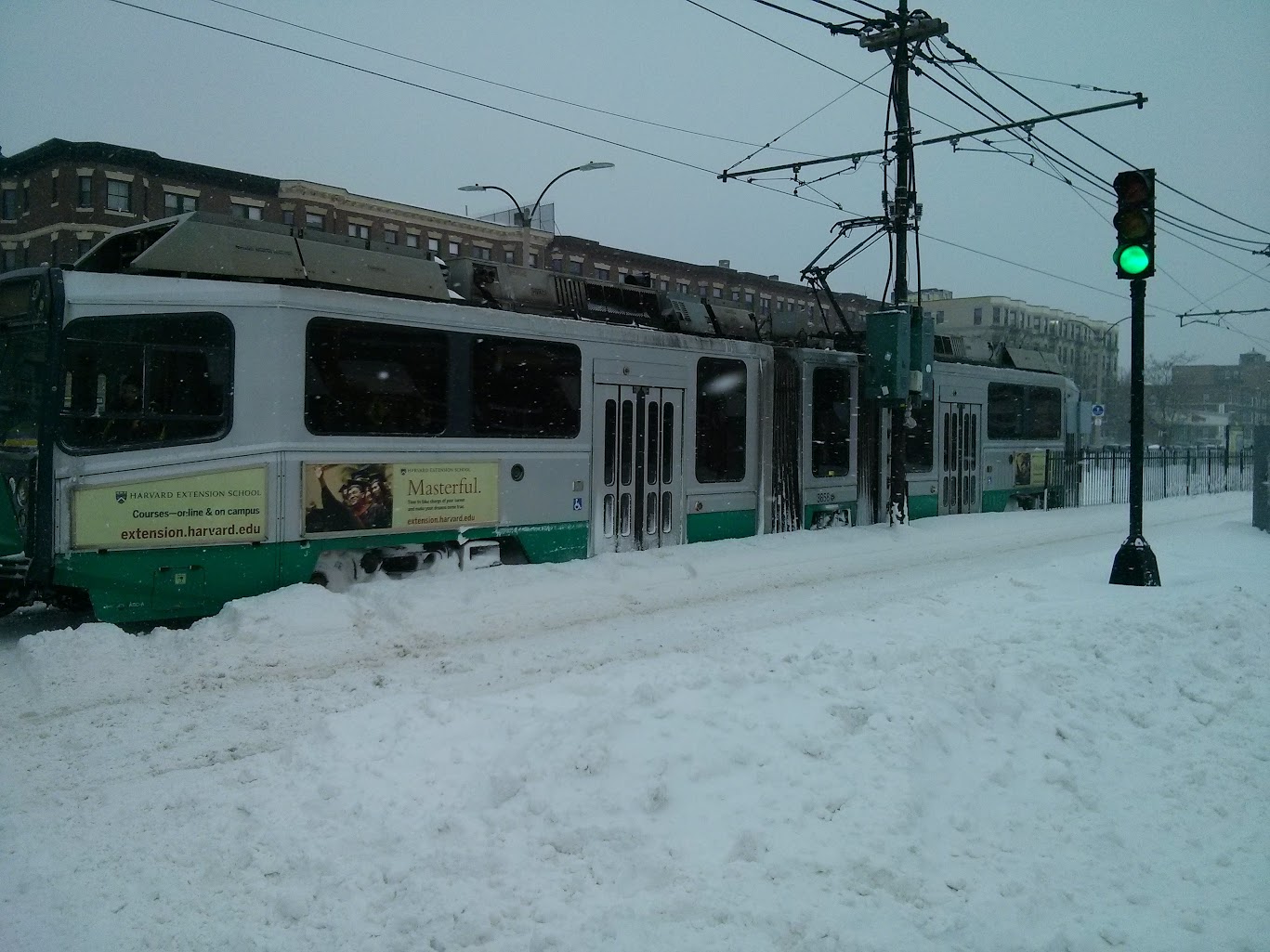
A curious pattern exists in Boston (I've also noticed it in other American cities). Neighborhoods that were primarily developed between 1890 and 1960 tend to have a lot of single-story retail. Oftentimes those retail shops are adjacent to multistory residential or office buildings, but the retail buildings themselves are single-story. Many of them are cheap boxes that look awful, while some of them do have decent architectural features that seem strangely out-of-place.
I'm sifting through some of my pre-snowpocalypse photographs for this post, so we can remember Boston as it once was.
 |
| The Fenway is a densely populated vibrant neighborhood with a strange dichotomy between retail buildings and residential buildings, like many other streetcar suburbs built around the same time. |
 |
| Another example from the Fenway. |
 |
| Double-whammy of bad 20th century planning: surface parking and single-story retail immediately adjacent to major Green Line station in Brighton. |
 |
| Same place, across the street. Typical of Comm Ave, there's a strip of single-story retail adjacent to 5-story or more apartment buildings. Some parts of Comm Ave do have ground-floor retail below residential, but it's the exception, not the rule. |
 |
| Union Square, Allston, with lots of great little shops and restaurants. But almost all of them are in single-story retail buildings. The tall building behind is from the 1980s, and does have a little bit of ground floor retail included, but is separate from most of the shops you see. |
 |
| Single story retail from the early 20th century. But as you can see, it used to be a whole lot better. Nowadays the building is used for storage of automotive supplies, and the intersection is a motor vehicle-dominated nightmare. In 1889, the first electric trolley line in Boston departed from the Allston depot along those tracks. Now, the Allston depot is a pizzeria with a giant surface parking lot. |
 |
| In the mid-1960s this theater was torn down to be replaced by a nearly featureless single-story retail building with surface parking out front. As the zoning regulations of the time would dictate. |
 |
| Single-story retail in the center of Hyde Park's business district. |
 |
| Single-story retail in triple-decker Dorchester, along Blue Hill Ave, where trolleys once roamed, and where frequent buses ply today. |
 |
| Single-story retail and massive surface parking near Forest Hills, a major MBTA subway, bus and commuter rail station. |
 |
| Single-story retail on Comm Ave next to a Green Line station. |
 |
| Tall residential, short retail, MBTA station: Brookline is no exception. |
In a city with an acute housing shortage, where space is at a premium, why do we allow so much waste to take place? It seems like there are hundreds of thousands of people who would like to be able to live in these neighborhoods with decent local shops, and in some cases, places that are only steps away from frequent MBTA service. Multistory buildings with ground floor shops and upstairs residences are not new in Boston -- they were quite commonly built in the 18th and most of the 19th centuries. The oldest neighborhoods in Boston: Beacon Hill, the North End, even the Back Bay, all have streets lined with buildings that have ground floor retail and homes above. Yet, starting around 1890 or so, it seems, some kind of insanity gripped America: suddenly, neighborhoods started being developed with apartment buildings on one block and single-story retail on another. Sometimes even on the same block.
I don't have a definitive answer, but there are several pieces in play:
- The criminally incompetent, so-called "City Planning" movement started around the turn of the 20th century, and these new planners were notoriously blind to the actual sources of city vitality and diversity. In some cases, they were opposed to city life, and actively sought to destroy it. Records from the City Planning Board of Boston show that many early discussions focused around choosing which buildings to destroy in order to widen roads. No doubt, they probably saw mixed uses as being "messy" and falsely perceived them as a source of traffic congestion.
- Property tax laws in this country can be counterproductive: they effectively penalize landowners who invest in their properties. In some cases, building owners may have chosen to cut down floors off their own buildings to save on tax expenses. In a sane world, such crazy outcomes would result in legislative self-examination and reform of the tax laws: for example, by repealing property taxes and replacing them with something less harmful like a land-value tax. In this world, well... no.
- In New England (and NY) it was common to quickly erect buildings that became known as "taxpayers" in order to generate some value quickly for the land without much effort. These taxpayer buildings were just enough to house some retail and then got locked into place when zoning came into effect around the mid-1950s. Many of the featureless boxes plaguing our landscape seem to fall into this category, but there are also plenty of examples of single-story retail with the kind of fine architectural detailing that seems out-of-place on a taxpayer.
- The economics of redevelopment seem to require a significant density boost in order to replace a revenue-generating property with a new one. If floors cannot simply be added to the top of the single-story building, and if the construction requires a shutdown of the business operating within, then the end result of construction has to be much taller than what previously existed. In the case of single-story successful retail, that probably means going up to 4-6 levels.
- And this discussion wouldn't be complete without mentioning the nefarious effect of mid-20th century zoning regulations. It is quite possible that many single-story retail buildings were intended to be temporary. But once zoning kicked in, redevelopment -- already difficult -- became near impossible. The density boost required to make redevelopment financially palatable was now illegal or required expensive variance hearings. In many cases, even the existing property was made illegal by unreasonable zoning requirements that demanded excessive amounts of parking that simply could not be provided in a space-constrained city neighborhood.
So, as a result, we have a bunch of neighborhoods where, if you somehow transported some people from 1915 one hundred years into the future to 2015, they might ask: "Why do you still have all these same crummy, single-story buildings that existed in my time?" ... After, of course, catching up on the past hundred years of history.
If we are serious about tackling the problem of rising housing costs and creating a better, more vibrant city that is accessible to all, then we will need to find a way to deal with these squat, inefficient, single-story structures. I often hear people complain that Boston is space-constrained, that we don't have room for development. That's not really true, as there are too many vacant parcels. But there are also many underutilized parcels in locations that can easily support much more. The replacement of single-story buildings that are located adjacent to frequent transit ought to be a high priority for all of the cities and towns in the region.