Pages

Sunday, January 15, 2012

Roads and highways are heavily subsidized

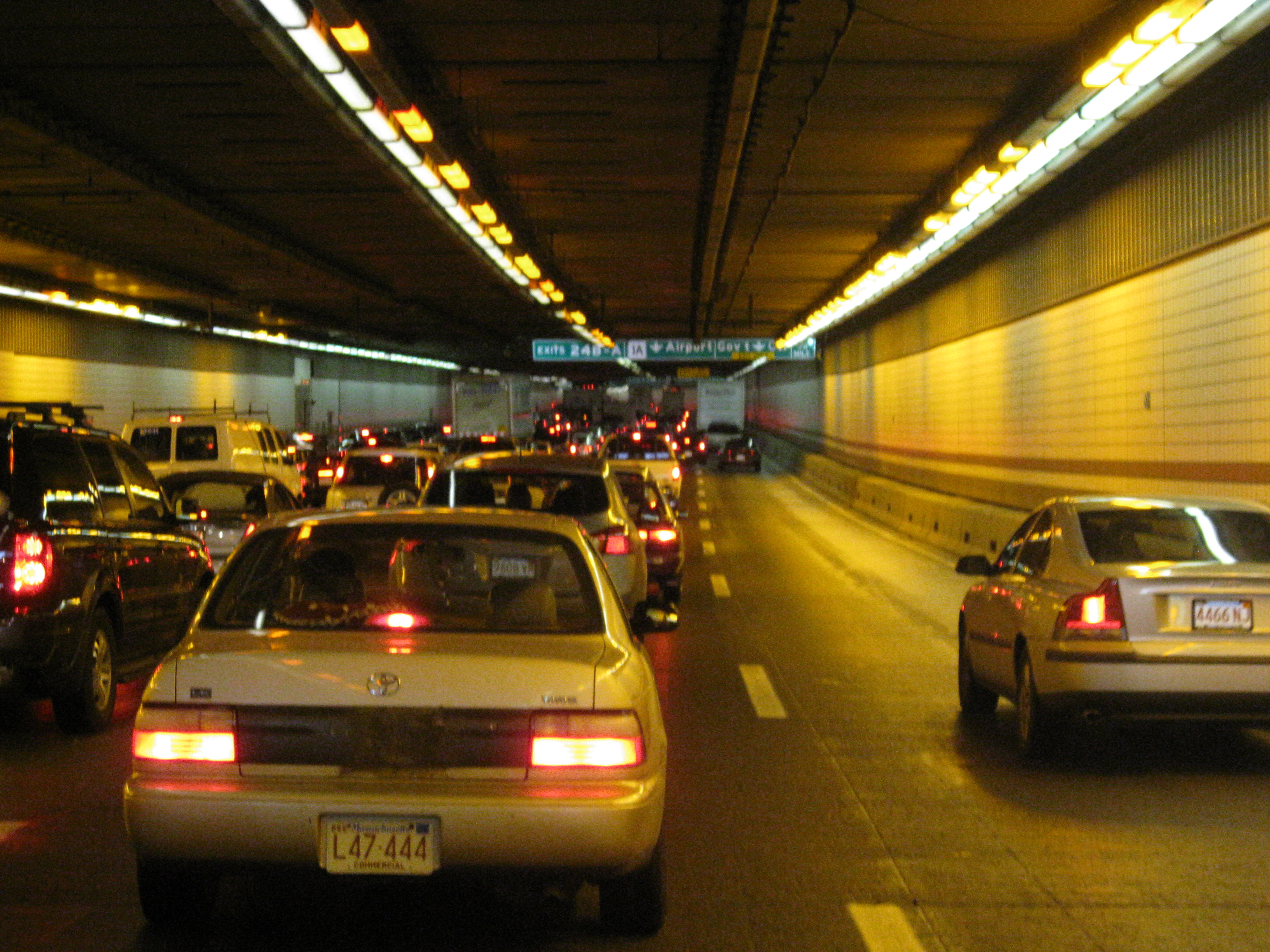
Interstate highway I-93 in Boston, part of the Big Dig (source)

Many people who own cars believe that they "pay their way," through the gas tax, when it comes to road construction and maintenance. That impression is a myth. To begin with, every single state in the country receives more highway funds than they contribute in gas taxes. Congress has appropriated an extra $30 billion to build and maintain interstate highways since 2008, taken from general funds. Many toll roads run deficits. The United States has one of the lowest gas taxes in the world. The Federal gas tax has not changed from the early 90s, it is a flat 18.4 cents per gallon. It is far too low to cover costs. According to the BLS inflation calculator, the buying power of the original tax has diminished by about a third, to 11 cents.

The situation at the Massachusetts state level is just as dire, if not more so:
The Finance Commission estimates that there is a funding gap of approximately $9 billion between what will be needed to bring the road and bridge system to a state of good repair and expected state and Federal funds.
Some have proposed a pay-per-mile tax (or VMT tax). As I've discussed before, this is a somewhat creepy and overly intrusive solution. It is much more reasonable to require only that commercial vehicles pay for VMT. Since commercial vehicles (trucks, buses) are already tracked by their operations managers, and they are not private passenger cars, it should be much easier and less objectionable to implement. Long-haul large trucks are already restricted to certain roads. Also, trucks and buses do the most damage to the roads, while passenger cars do relatively little.

Rocky Mountain Double (source)
Arguably, it should be car owners who have the most interest in this kind of proper taxation. The damage done to the road appears to be approximately proportional to axle load raised to some power between three and four. That means trucks and buses do extreme amounts of damage to roads compared to passenger cars. Only a few states even care about truck weight, and none of them come close to recovering the costs proportionally. So, ordinary drivers are paying much of the costs of trucking.
Modern freight rail container shipping (source)

There is a wider benefit to having roads. I'm not opposed to using public funds for road projects, I'm opposed to people who pretend that we don't do that. Roads are not free, and they are heavily subsidized by state and federal governments. To claim otherwise is dishonest. The gasoline and diesel fuel taxes must be brought into line with year 2012 costs, and set on a solid track for the future. States should strongly consider recovering the true cost of supporting heavy freight trucking on their roads through a commercial VMT tax, instead of putting the burden on the ordinary taxpayer. Businesses that need to transport freight long distances would go back to more appropriate modes, such as the railroads, which have improved their operations tremendously in the last 30 years. Not only would this reduce the cost of maintenance on our highways, but it would increase safety and reduce congestion at the same time.

The current, nearly 20 years old, Federal gasoline tax rate should be indexed to inflation, and raised from 18.4 cents per gallon to 28.8 cents per gallon (38.2 cents per gallon of diesel). This data on trucks and VMT in 2002 suggests that the majority of trucks are in the 60,001lb to 80,000lb range, traveling about 77 billion miles on our roads, out of approximately 145 billion truck miles overall. Presumably, these numbers have only gotten larger in the last ten years. Still, at those rates, an average tax rate of 10 cents per mile would recover over $14 billion that would be directly correlated with road damage. To be fair, lower weight trucks should pay significantly less than higher weight trucks - perhaps even following the power law to some extent. For example, if 80,000lb trucks pay 20 cents per mile, then 10,000lb trucks could fairly pay 0.04 cents per mile, given some simplifying assumptions. Of course, to get a real idea of the effect of VMT fees, it will be necessary to model the reduction in truck traffic (and reduction in road damage) that would result, as well as the costs of administration.

Update:
Do Roads Pay for Themselves?:
Since 1947, the amount of money spent on highways, roads and streets has exceeded the amount raised through gasoline taxes and other so-called “user fees” by $600 billion (2005 dollars), representing a massive transfer of general government funds to highways.
Rank hypocrisy on 'subsidies':
Today, over-the-road heavy trucks pay approximately $14,000 per year in combined fuel and other highway taxes. This amount does not come close to paying for the damage to roads and bridges caused by trucks, let alone the capital cost of the highway system or for new or expanded road and bridge construction.

Thursday, January 5, 2012

Open Public Comment Letter

Regarding the plan to raise fares and cut services on the MBTA:

The public transportation services provided by the MBTA are crucial to the region's economic success and quality of life. Yet, the Commonwealth's plan for handling the funding of this agency has failed. In 2000, the legislature attempted to put the agency on its own financial footing through the passage of "forward funding." This plan was to provide 20% of state sales tax revenue to the agency, and in return, the agency would henceforth manage and discharge its own debt. The newly reborn agency was handed the responsibility for its existing debt -- but was also forced to takeover $1.8 billion in Central Artery/Tunnel commitments.

Since 2000, the predictions that "forward funding" was based upon have turned out to be wrong. Sales tax growth was conservatively estimated at 3% a year. In fact, it has been approximately 1% a year. Energy costs to run the system have sky-rocketed, as well as health care costs for employees. The legislation that was supposed to make the agency independent has instead hamstrung it with an unsustainable debt load.

In 2007, the Transportation Finance Commission issued this following recommendation:
The MBTA has over $5.2 billion in outstanding principal debt and paid $351 million or 27 percent of its operating budget on debt service in FY 2006 – more than the total of all fare revenue collected. About 35 percent of the principal amount of the outstanding debt ($1.8 billion) is directly attributable to carrying out Central Artery/Tunnel commitments. That debt is rightly the responsibility of the Commonwealth, not the MBTA. Level-funded over a 20-year period, this would shift about $117 million in debt payments from the MBTA to the Commonwealth. It should be emphasized that this debt must still be paid. The substance of this recommendation would transfer this obligation from the MBTA to the state budget.
This $1.8 billion in Central Artery/Tunnel debt was incurred by court-mandated projects that the Commonwealth was required to fund, in order to receive approval for the Central Artery/Tunnel in the first place. It is time to enact the recommendation of the Transportation Finance Commission, and put the Big Dig debt on the Commonwealth budget where it belongs. This action alone would go a long way to closing the budget gap for the next fiscal year.


(mailed to the public comment address found in the MBTA news article)

Wednesday, January 4, 2012

Fix Forward Funding First!

The MBTA has over $5.2 billion in outstanding principal debt and paid $351 million or 27 percent of its operating budget on debt service in FY 2006 – more than the total of all fare revenue collected. About 35 percent of the principal amount of the outstanding debt ($1.8 billion) is directly attributable to carrying out Central Artery/Tunnel [Big Dig] commitments. That debt is rightly the responsibility of the Commonwealth, not the MBTA. Level-funded over a 20-year period, this would shift about $117 million in debt payments from the MBTA to the Commonwealth. It should be emphasized that this debt must still be paid. The substance of this recommendation would transfer this obligation from the MBTA to the state budget.

It's abundantly clear from many sources that the Forward Funding legislation of 2000 has been a failure and needs to be revisited before considering fare hikes and service cuts. In 2009, the MBTA Advisory Board published a review of the MBTA. This report explained, with excellent charts, how the Forward Funding failed to live up to expectations. In short,

  • Sales tax revenue was far more anemic than ever imagined in the 1990s.
  • Energy costs have increased dramatically more than expected.
  • The Finance Plan inexplicably did not predict any increase in health care costs.
  • Paratransit expenses increased due to growth, increased vendor fees, and fuel costs.

The granted portion of state sales tax revenue was supposed to make up for the debt obligations that were shoveled onto the agency. As the debt was paid down, the MBTA could manage its own finances "forward" from there, independently from any further state support. Instead, the plan backfired on all parties, and the MBTA began digging itself into a hole just to pay for maintenance and operations on top of the existing debt service. More from the review:
The only major long-term operational success of Forward Funding is the fact that the riding public paid three fare increases in the last eight years. That resulted in a cumulative $95M gain. Asking that same public in 2010 for yet another fare increase because Forward Funding did not work defies credibility. The riding public deserves to have tangible evidence that the MBTA is improving safety and service—not deteriorating further.
It is now 2012, and the MBTA is formally proposing a fare increase as well as service cuts, to cover a $163 million deficit. It is time to follow the Transportation Finance Commission's recommendations and fix forward funding first, by moving the Big Dig debt commitments back to the state budget where they belong. This could cover approximately $117 million of the projected deficit, leaving a much more manageable $46 million shortfall to be addressed.

Tuesday, January 3, 2012

MBTA plans service cuts and fare increases

The big story today is that the MBTA has published their proposal to cover a $161 million budget gap by cutting service and raising fares. They have put forth two scenarios: the first one raises fares higher, and the second one cuts back buses further. Both will end weekend and late-night service on the Commuter Rail, as well as weekend service on the "E" branch and the Mattapan line, among other things.

The broken forward funding legislation, from over ten years ago, continues to put the squeeze on public transportation in this state. There will be 20 public meetings, and opportunities for the public to comment on this proposal. It's time to get the Big Dig debt off the MBTA. Please try to write to the MBTA and attend these meetings if you can, and also write your state representatives.

The Big Dig, part 3


Were the Big Dig cost overruns unpredictable, due to the tricky nature of tunneling through the heart of a city? Or was it something else? From A History of Central Artery/Tunnel Project Finances 1994 - 2001:
Records and interviews reveal a Big Dig cost history at odds with publicly disclosed information. Most significantly, records show that B/PB presented Big Dig officials with an excruciatingly detailed total cost forecast of $13.79 billion in November 1994, a figure close to the $13.8 billion revised estimate announced by Big Dig officials in October 2000. [...]
Anxious to avoid the sticker shock effect of B/PB's estimate, Big Dig officials undertook a nine-month initiative between June 1994 and March 1995 to decrease B/PB's total cost estimate from $13.8 billion to $8 billion. At this time, the Secretary of Transportation and Construction publicly announced that the on-time and on-budget figure would not exceed $8 billion. Documents cite a directive from Big Dig officials telling B/PB to "hit the target" of $7.98 billion. [...]
B/PB managers insisted that local FHWA officials be told about all deductions, assumptions and exclusions that had been used to reduce B/PB's cost projection. Records show that B/PB and Big Dig officials did so. [...]
Once local FHWA officials learned of, modified, and sanctioned the use of these multi-billion dollar accounting assumptions during the 1994-1995 CSU-Rev.6 budget review process, the accounting assumptions became a permanent, tacit feature of the budget. [...] 
Put another way, once local FHWA officials gave their approval to the use of these accounting assumptions in 1995, they became part of the "semantic" definition of the Big Dig's total cost. The accounting assumptions became a multi-billion dollar minimizing factor for every cost estimate that followed.
Starting in 2000, the Massachusetts Office of the Inspector General began investigating the cost cover-ups behind the Big Dig, and they published their findings in a March 2001 report. They found that state officials ordered Bechtel/Parsons-Brinckerhoff to arbitrarily cut $6 billion from the estimated cost, in order to meet a political goal.
Page 44 of the OIG report

The report concludes that since the FHWA was made fully aware of the reductions and their nature, it is responsible for accepting the bogus $8 billion number and giving respectability to it. Therefore, the Federal funding cap should be raised, since it was based on information the FHWA knew to be unrealistic, and that when the Massachusetts Legislature provided state funds, it did so "in the absence of critical information." (p. 16)

Frankly, although the Mass OIG report is revealing, I think it is somewhat self-serving by implicating the FHWA so heavily. Was the FHWA complicit in hiding the true costs of the project? Yes, it appears. But the duplicity was the direct result of orders from Big Dig officials. Shouldn't they be the ones held responsible for manipulating numbers for political reasons? As for B/PB, they did do the shady accounting they were ordered to do, they also provided all the information about it to the FHWA and investigators. Anyway, there is a whole sordid list of errors to charge B/PB with aside from this.

The OIG report was published over ten years ago. What happened? According to this report (pp.15-18), the Attorney General determined that the report was not sufficient to make a criminal case, and it appears that the remaining cost recovery effort was rolled into a larger lawsuit over a collapse in the I-90 connector. But at least we know that the cost overruns were largely just a return to B/PB's original prediction, which turned out to be pretty accurate.

See also: The Big Dig, part 2, part 4.

Monday, January 2, 2012

Don't Walk


There is an intersection along Commonwealth Avenue, at Babcock Street, which always puzzles me when I am walking there. At one corner, there is a pizza shop. Catercorner to that is a charter high school. The other two corners have bus stops. When you cross Commonwealth Avenue, there are pedestrian signals to guide you. But when you cross Babcock Street, there are no pedestrian signals. What's worse, there is a green arrow telling drivers that it is always OK to turn right -- next to the high school -- but no safe phase for pedestrians. Children are given the option of crossing against a green arrow, crossing against the light, or not crossing at all.


I figure that it is only a matter of time before a tragic accident occurs: when someone comes speeding around the corner, and doesn't slow down because they are given a green arrow. I finally got around to taking pictures and filed a Citizens Connect report about it last month. A few days later I received this response:
status: Closed. Case Noted. Pedestrian walk indications will be installed under a massachusetts department of transportation project which is in the final design stages.
That is interesting. They did not link the project, but I believe that they are referring to MassDOT #606284 based on the description: Improvements to Commonwealth Avenue from Amory Street to Alcorn Street. I haven't found any more information on this, and it doesn't look like much has happened yet. I know this intersection has already existed in this state for at least three years, and it looks like it will be awhile yet before it is fixed.

Update: I've heard that this project may be scheduled for 2015, so I suppose we have that to look forward to.

Thursday, December 29, 2011

Madrid Rio: Highway Tunnel Project

I was lying flat on my back, sprawled across a marble platform, looking at the high ceilings above. I had just stepped off the escalator to the Metro terminal at the brand new (ridiculously large) Madrid Barajas airport,  when I slipped and fell. I was in a hurry: I could see that the next train was about to depart, but at this point I wouldn't make it in time. A custodian was mopping nearby, he came over, helped me back up, and asked me in Spanish if I was OK. I summoned up the little language training I had and asked "¿Cuando proximo tren?" He pointed wordlessly at the other track, where the doors were open on yet another train. I sheepishly schlepped my bags there, and within a few minutes, we were moving.

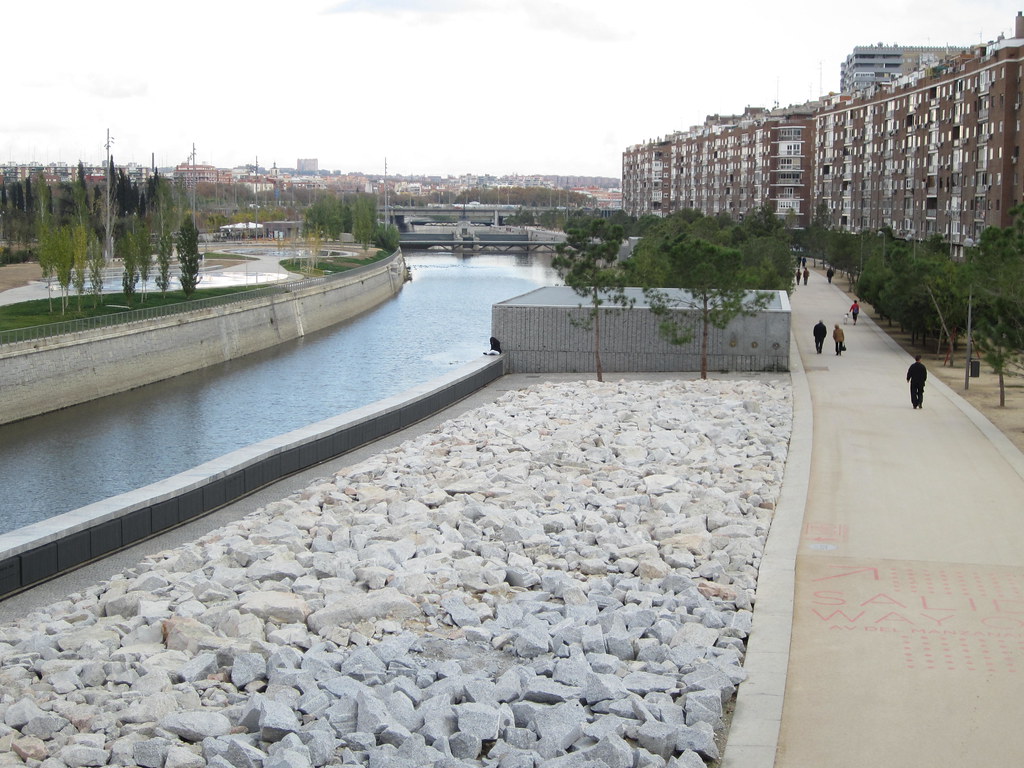
Riverside promenade, Madrid (source)

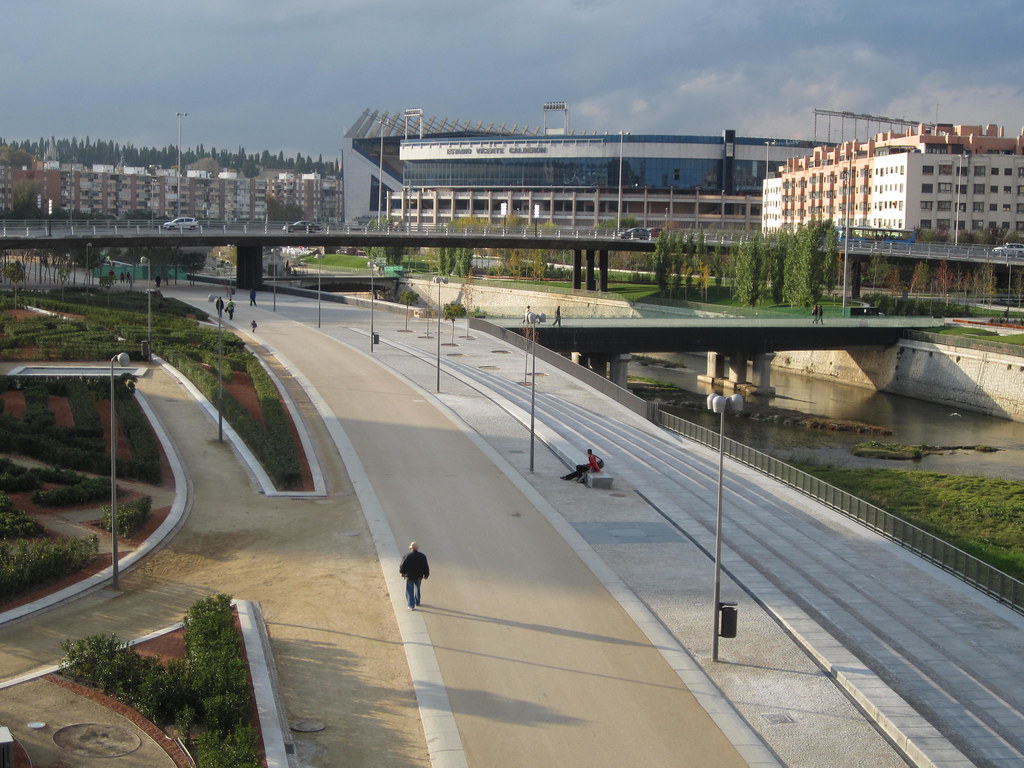
That was my introduction to the city of Madrid, in 2010. This past year, they completed their own version of the "Big Dig", putting the M-30 beltway underground, and restoring the Manzanares River. The project is called "Madrid Rio" and tunneling was started in 2003 as an effort to reclaim the riverfront land and improve the busy M-30 at the same time.

When I visited for a conference in 2010, I got to spend my free time exploring. I remember there being a river on the maps, and I did visit points on both sides of it, but I do not remember ever seeing the river itself. Apparently, I'm not the only person with this experience. Up until recently, the river was treated as a neglected median for the M-30. The park is so new that Google's satellite imagery still shows it under construction (as of this writing).
A highway runs beneath (source)
Already, comparisons have been made between this project and others around the world. Let's start with the basics.

Madrid Rio
Ten kilometers of tunneling, seven years of construction, 300 acres of new parks, €400 million (~$550 million) to build the park, out of approximately €4 billion (~$5 billion) for the entire project.

The Big Dig (Central Artery/Tunnel)
Over eight kilometers of tunneling, 10-20 years of construction (depends what you count), 26 acres of reclaimed space, $15 billion (or $22 billion with interest). This was really two mega-projects rolled into one, so it is difficult to compare directly. This site attributes $6.5 billion to the I-90 extension, leaving about $8.5 billion for the 5-km Central Artery.


Spain, it seems, is really good at building infrastructure cheaply. But to be fair, the project in Boston was a lot more complicated. The M-30 ran alongside the Manzanares River, which had never been an important part of the modern city of Madrid. The Big Dig took place in the heart of downtown Boston. It appears that the tunneling for the M-30 was relatively simple: not much to worry about except for some subway tunnels underneath. The Big Dig required the relocation of underground utilities, it had to thread below South Station, around both the Red Line and the Blue Line, all while supporting the weight of the Central Artery above. Madrid was willing to screw over residents during construction, in ways that would be unacceptable here in the States. I do not know to what extent this made it easier for them.

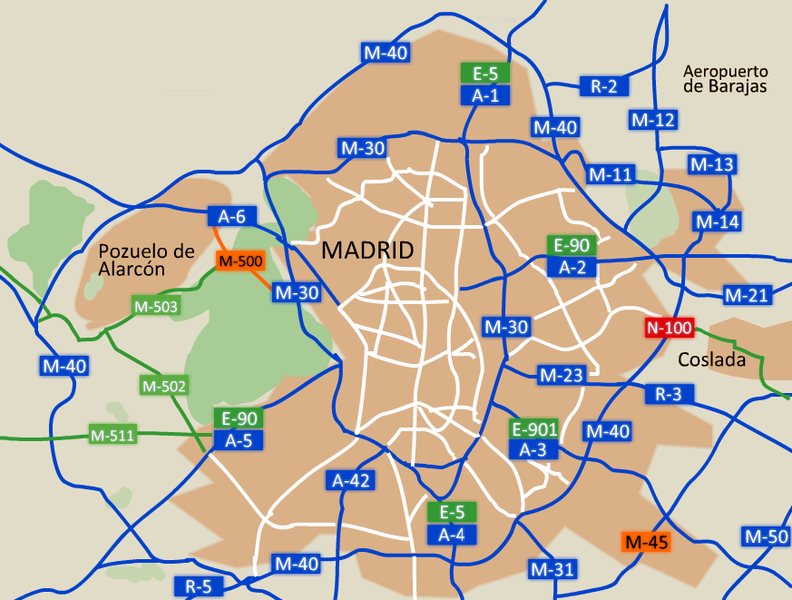
Madrid highway network (source)
The most effective way Madrid saved money, however, is by never building a city-dividing highway in the first place. The M-30 is the inner belt, and the highways that lead into the city end there. It may be hard to tell from this map, but the region within the M-30 beltway is quite large. It includes the heart of the city, and many of the inner neighborhoods. However, the outer barrios are crisscrossed by highways, and I have heard that traffic on them is quite heavy.

To counter this, Spain has been pro-active about building and maintaining public transportation. The Madrid Metro is currently sixth in the world in terms of length. I can attest that, when I visited, the system was largely clean and modern (having undergone renovation in the last ten years) and very extensive for a city of that size. This is complemented by buses as well as commuter, intercity and high-speed railroad operations.

I don't know if Madrid Rio will be successful. The alleged benefits are the creation of a new river park, the revitalization of many properties abutting it, and new development to go alongside. Will Madrileños still stroll the riverside when the novelty has worn off? Perhaps: the park includes many new bridges and connections to Casa de Campo, which was cut off from the city previously. Even so, it may not be worth the cost -- which was fairly high by Spanish standards.

Friday, December 23, 2011

The Big Dig, part 2


The Greenway
A prescient Boston Globe article:
The year is 2010, and tourists are scurrying across the surface of the submerged Central Artery, avoiding cars and checking maps to get from Faneuil Hall to the Aquarium. Mothers with strollers are leaning into a gusty wind, passing through a barren park where no one lingers.
I have made one small change to the quote. The authors felt they were exaggerating when they wrote those words in 1999. However, a mere ten years later, the Rose Kennedy Greenway has already become the barren park that they had envisioned.

But you don't have to take my word for it. In late 2011, a political movement known as Occupy Boston took over the open space near South Station called Dewey Square -- part of the southernmost portion of the Greenway. Eventually a Suffolk Superior Court ruled that the city could evict them. As part of that ruling, the judge provided a description of the space:
Developed as parkland, the locus in quo is a hundred-foot wide median strip, which covers an interstate highway tunnel and is bounded by an exit ramp and heavily trafficked streets. It is operated by the Rose Fitzgerald Kennedy Greenway Conservancy, Inc. and is known as Dewey Square.
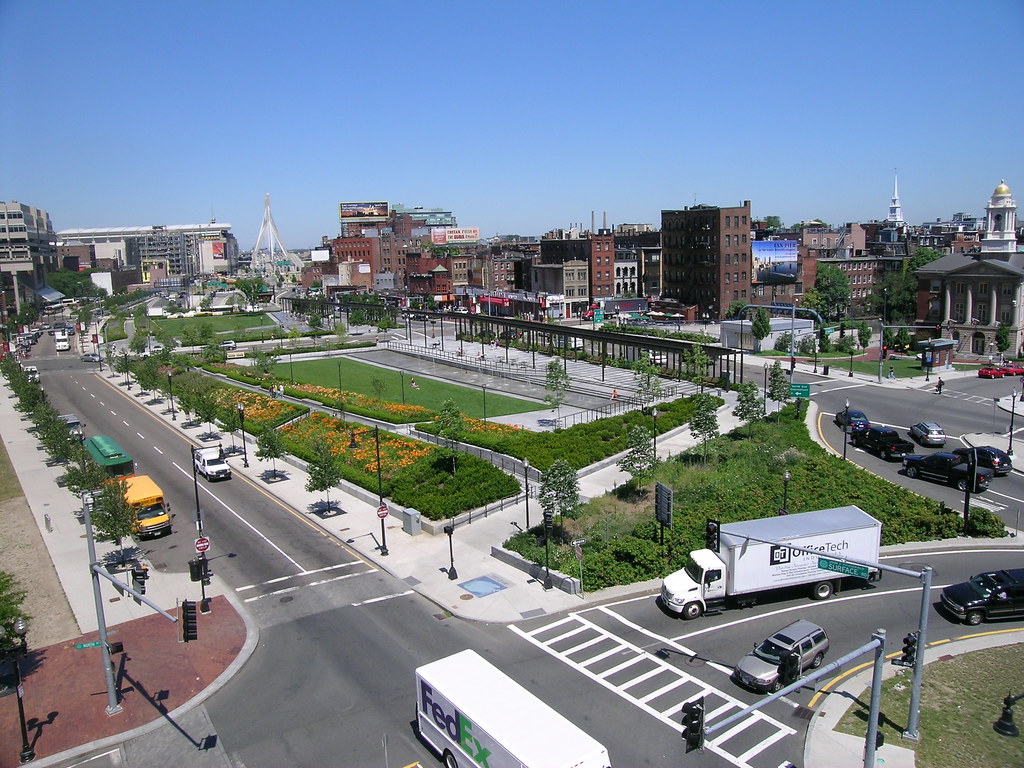
Many decades and dozens of billions of taxpayer dollars were spent on designing and constructing the Big Dig. It was supposed to open up nearly 30 acres of prime downtown real-estate, and reunite the city. But when former environmental secretary John DeVillars approved the plan, he inserted an arbitrary stipulation that 75% of the land be used for "open space." Also: as it is constructed, the tunnel underneath will not support any building taller than a few stories. As a result, nearly all proposals for the land focused on different ways to turn it into a park, or worse, a parking lot. And in the end, what have we got for all of the effort? A six lane divided highway, at-grade, with "open space" in the middle. See for yourself:


$15 billion buys you a tunnel, a new at-grade highway and a glorified median strip (source)

"Pedestrian friendly" connection to the North End (source)


Northernmost section - perhaps the nicest part but still very highway-like (source)
We didn't get redevelopment of the urban fabric to replace what was demolished fifty years ago. And we didn't get much of a park either. Just a barren "open space." Or as Charlie Gardner put it: they made a desert and called it a park.

He also asks: did anyone consider the option of removing the Central Artery, and not replacing it? After all, the 1989 Loma Prieta earthquake forced San Francisco to do that to the Embarcadero Freeway, and the result has been overwhelmingly positive for them. While people have made comparisons between that highway and Boston's Central Artery, nobody seems to consider if what worked for them might have worked for us as well.

Consider this segment from a fascinating interview with Fred Salvucci, where he explains how the idea for the Big Dig came about:
Initially Bill Reynolds, who was a highway builder and the head New England Road Builders, came up to me and said that, "This big ugly elevated road is like a neon sign flashing, 'Roads are bad.' And it's just a bad advertisement for our industry and I'm convinced that the only way we'll fix this anti-highway attitude is by correcting the mistake and putting it underground." And my first reaction was, "This is crazy. You know, how are we going to shut the city down for ten years while we build a new road?"
Two things: perversely, the Big Dig project grew out of the anti-highway movement (the interview discusses this at length), and Salvucci felt that shutting down the Central Artery was tantamount to shutting down the city. As far as I can tell from my research, that presumption -- spoken or not -- is never questioned.

See also: The Big Dig, part 1 and part 3.

Wednesday, December 14, 2011

Nathan Lewis continues to embarrass himself

I've written about this before. Nathan has written an excellent and inspiring series of articles about traditional urbanism, beginning with The Eco-Metropolis. But he's also a gold-standard crank. This poses a difficulty for me. How can I recommend his site to people, when they will find some really bad writing on economic issues there?

Let's take a look at his latest offering:
The distinguishing characteristics of a Keynesian are easy to identify. In response to a recession, they recommend expanded government spending – they usually boast outright that it doesn’t matter what the money is spent on, even egregious waste — and some sort of “easy money” policy. [..] Keynesians generally don’t have any ideas except for these. None at all.
Wrong, Nathan. This theory of macroeconomics draws from the work of English economist John Maynard Keynes who surmised that it was possible for individual "rational" decisions to add up to an inefficient overall outcome. In other words: markets were not perfectly self-regulating and they could lead to extended human misery for no good reason. Therefore, an active government policy role -- both fiscal and monetary -- was required to tamp down the excesses of the business cycle. Keynes was especially interested in solving this problem because of the Great Depression. Many of the ideas found in his work are older, but have been grouped under "Keynesian economics" because he put them together into one general theory.

What does all this mean in practice? The simplest answer is this: the government plays a counter-cyclical role relative to the private sector. When times are good, and the economy is booming, the government should take steps to pay down its debt and reduce inflation. When times are bad, and a depression is looming, the government should do whatever it takes to prevent unemployment from passing a critical level, even if that requires taking out loans and providing "stimulus." The former principle is just as important as the latter.

Keynesian economics provided models that were successfully used for the following forty years to manage the economies of many countries, including the United States. However, those models were unable to explain the phenomenon of hyper-inflation in the 70s, so they went out of favor, and some alternatives have come and gone, including monetarism, the Austrian school and Real Business Cycle theory. Other economists responded to critiques by producing New Keynesian models, instead. Since 2007, as we nearly dipped into a second Great Depression, Keynesian-style economics has been re-popularized, as the alternatives have all failed to explain the conditions we are seeing today.

For example, Nathan goes on to make this claim:
Today, Keynesianism is in its era of final absurdity. With governments now running into their borrowing limits across the globe, the idea of deficit-spending your way to prosperity is mostly off the table.
If Nathan and his cohort of Austrian economist friends were right, US treasury rates would be sky-high. Unfortunately for him, he didn't bother to check the facts. If he had, he would have learned this:

Far from running into any kind of "borrowing limit", United States Treasury bonds are more popular than ever. People are willing to loan the government money at a zero percent interest rate! Even when real interest rates have dipped into negative numbers, people are willing to effectively PAY an interest rate in order to hold bonds. So much for final absurdity.

Still obsessed about gold:
The United States used a gold standard system for 182 years, 1789-1971, and became the wealthiest country in human history.
Except, of course, when FDR abandoned it in order to save the economy during the Great Depression. And then there's the period of economic growth following WWII, when Keynesian thought guided the creation of the Bretton Woods system, based heavily on capital controls.

More silliness:
At that point, a gold standard system will seem straightforward and inevitable. Once you decide that you want Stable Money, instead of Ben Bernanke’s funny money fiesta, the solution is obvious.
And reality:

Inflation as measured by CPI has trended low and stayed under 2.5% since the beginning of the crisis. It nearly dipped to zero, and by some measures, we saw deflation for some months in the last couple years.

I have been talking generally about Keynesian macroeconomic theories, and how they have been successful in recent years compared to other theories, while objecting to Nathan Lewis's characterization. To be fair, the issue is far more complex than this: there are many models, and none of them are perfect for every situation. If you are interested in learning more about this, you should go ahead and read about how real economists work. Whichever way you go, the most important thing is to check predictions against the real world data, which is easier than ever to do nowadays.

It is really frustrating for me to have to debunk Nathan. I really like his writing on cities, his style is a lot of fun to read. But these economic matters are also important. And sadly, he is better known for his crank writing than his good writing.

Saturday, December 10, 2011

The Big Dig, part 1


The Big Dig (source)
The most expensive highway project in the United States was built here in Boston. It was nicknamed "The Big Dig", a name that became notorious and synonymous with massive cost overruns and delays.

So when the highway segments were finally completed, many people were eager to put the whole mess behind. The cost was high, but at least we had some shiny new bridges and tunnels to use. Also, the space formerly occupied by the Central Artery had become open land, with grass and marginal roads.

However, the Big Dig did not live up to its promise, and may have made some traffic patterns worse. The Boston Globe conducted an investigation and published an article in November 2008:
Ultimately, many motorists going to and from the suburbs at peak rush hours are spending more time stuck in traffic, not less. The phenomenon is a result of a surge in drivers crowding onto highways - an ironic byproduct of the Big Dig's success in clearing away downtown traffic jams.
The State of Massachusetts has spent $15 billion on a fight against "The Fundamental Law of Highway Congestion," and the Law won. The original paper was published in 1962. There has been plenty of research over the years on this subject, and there was no excuse to be unaware of the dilemma by the early 90s when the Big Dig planning was underway.
Proposed Green Line extension

The trouble does not end there. The State agreed to mitigate the pollution from the additional vehicle traffic induced by the Big Dig. To this end they made legally binding promises to build several public transportation projects, including: Green Line extension to Medford, Arborway trolley restoration, and Red-Blue subway connection. However, the MBTA has weaseled out of Arborway by substituting improvements to the 39 bus, and has moved on the other projects only when threatened by lawsuits. The Green Line extension was recently pushed back, yet again, causing widespread anger among residents and elected officials. The State government apparently thinks that, with the completion of the highway segments, it can brush off any further obligations to the citizens.

In 2000, in an attempt to fix the finances of the MBTA, legislation called "Forward Funding" was passed. This law dedicated 20% of sales tax revenue to the MBTA, and in exchange, charged the agency with issuing and paying its own debt. People were assured that this would be sufficient to run operations. However, the legislature also did something sneaky: they moved $3.3 billion of debt from the State onto the books of the MBTA. Part of that debt was from the Big Dig. The reformed agency was "[Re-]Born Broke:"
Legal obligations debt ($1.688 billion) corresponds to state implementation plan (SIP) commitment projects.  These were public transportation projects the state agreed to build as part of the Big Dig.  [...] The State also transferred the responsibility to finish many SIP commitment projects, and the T borrowed to do so.  In 2007 the State agreed to re-assume responsibility for outstanding SIP projects, but not the debt for such projects borrowed before 2007.
In other words, the State of Massachusetts had made a binding agreement with the citizens that, among other things, it would improve the public transit systems managed by the MBTA in exchange for constructing the Big Dig. But less than ten years later, Beacon Hill was able to completely twist the logic of this agreement around. Now the MBTA alone is being forced to bear the debt burden that the State was supposed to pay  in the first place. And the revenues from sales tax never met the original expectations. The result is a system that is breaking down and cannot pay for desperately needed repairs. We are looking at possible fare increases, up to an outrageous $3.25 per ride using CharlieTicket, and severe service cuts. This plan could demolish ridership on the system, leading to a spiral of further deficits. And if that happened, it would not only hobble mass transit, but also the entire economy in the Metro Boston region which depends on the T.

See also: The Big Dig, part 2