Boston drivers are well known to flagrantly violate traffic laws. I've debated whether to write about this topic, since it's such a frequent occurrence that it's pretty much just another fact of life here. But if nobody writes about it, then it just gets left unsaid.
I often have qualms with the pedestrian signals around here. Many times, the beg buttons simply don't work. In this particular instance, they did work, but it didn't matter. Standing at the corner, I waited for a car to complete its right turn. I saw the pedestrian signal light up: Walk. But out of the corner of my eye, I saw another van that was not stopping. It was going to turn on red illegally, despite the sign: No Turn On Red. How typical, I thought, and so I stepped into the roadway and waited for it to pass. Were that all, it would be unremarkable. But then I continued to try and cross the street, and I realized that yet another van was trying to push through. A red work truck, with some lettering on the side: likely a contractor or similar business vehicle. Was he going to stop? My usual approach is to try and get eye contact with the driver. I step out far enough to assert my presence -- the pedestrian signal is Walk, this is my right-of-way -- but not so far that I can't get out of the way of a lunatic. In this case, he changed his mind and stopped short. Made some kind of gesture with his arm. I don't know what, and I don't care. The moment I passed, he stepped on the gas and blew through the crosswalk, heedless of the law.
Just another day in Boston. I'm sure many others can relate similar stories. Despite this, I've only been hit by a car once, a few years ago, and it was minor. I was walking along the sidewalk down Newbury Street in the Back Bay when I noticed that a car was trying to pull up into the driveway I was crossing. I saw the driver; she didn't stop. As the car rolled up to me, I put my hands onto the hood of the car and lifted myself over the top; she stopped abruptly and tossed me back onto my feet. I wasn't hurt so I let it go.
We've been rated the safest walking city which might be hard to believe after reading this post. My theory is that pedestrians don't trust drivers, and drivers don't trust pedestrians. This mutual distrust keeps everyone on their toes. You can't trust Walk signals, or traffic lights: this forces people to be aware of their surroundings. In the Sunbelt cities where fatalities are high, the roads are designed for cars only, and pedestrians are trained to rely too heavily on signals for safety: when someone violates a signal, they catch someone else off-guard. In Boston, drivers blow through red lights all the time, and pedestrians disregard signals as a rule. The result: safer conditions than the best laid plans of traffic engineers. Of course, we could still do better yet. Cars are driven too dangerously in this town. Yes, there does seem to be a counter-intuitive safety effect -- but it only works up to a point. And I think we are already beyond that point and down the slope of diminishing returns. In cities where the drivers are truly reckless and chaotic, those who venture out without a two ton coat of armor are the ones who suffer most.
Sunday, February 12, 2012

Tuesday, February 7, 2012
'A wild kid from the suburbs'
It's week 2 for the reading group and the chapter is 'The uses of sidewalks: safety'. Heather and Steven have already covered some interesting ground on this chapter. While re-reading it, I was struck by one passage in particular:
One night a young man came roaring along, bellowing terrible language at two girls whom he had apparently picked up and who were disappointing him. Doors opened, a wary semicircle formed around him, not too close, until the police came. Out came the heads, too, along Hudson Street, offering opinion, "Drunk ... Crazy ... A wild kid from the suburbs."*
* He turned out to be a wild kid from the suburbs. Sometimes, on Hudson Street, we are tempted to believe the suburbs must be a difficult place to bring up children.Then later, as if on cue, I read this report in the paper:
A 19-year-old Andover [N.H.] man allegedly punctuated the end of a Super Bowl party at the Residences at the Ritz-Carlton in downtown Boston by beating two other men with a pistol, authorities said today.Then and now, this is an common kind of story around Boston, and I would suppose in many other cities. It's only natural for people to come from out of town for 'recreational' purposes. But some blow it out of proportion, and then they end up in the next day's papers.
Saturday, February 4, 2012
Looking at real-time Commuter Rail data
Last year, the MBTA began releasing real-time GPS tracking data for the Commuter Rail. This data contains the current locations of trains in service, as well as the predicted times of arrival for the following station stops. An important note: the data feed is still considered to be in "beta" testing and therefore is not entirely reliable.
In anticipation of yet another tough winter, I began recording the real-time data into a PostgreSQL database on a personal server, starting in mid-November. With over a million rows stored, representing nearly three months of data, I have started to do some preliminary analysis. One important caveat: while looking through the database, I noticed that there are some gaps. Certain trips do not have the expected amount of data recorded. The reason for this is unknown, but I speculate it may have to do with the GPS device onboard certain trains being broken or misconfigured.
First I looked at an overall measure of lateness, taken by looking at all trips and measuring the difference between scheduled arrival time at their terminal destination, compared to actual arrival time. All times are represented as "hh:mm:ss".
Then I broke it down by line:
And also by day (using a Zoomable Line Chart showing average and maximum lateness measured in seconds):
Click "Load all content" if this doesn't show
The previous three tables look at lateness of a trip by comparing the final scheduled station stop against its actual time. But what about all the other stations? It turns out that trains can often make up time enroute, so that they may arrive on-time or early to their terminal but were late to intermediate stations. The following two maps look at average lateness, according to the real-time predictions of every train, of each station stop on the way. I have split the data into two parts: the first map displays inbound trips, and the second map displays outbound trips. You can view the average lateness in seconds by clicking on a station marker. The color codes are divided into four buckets: green dots average under 1 minute late, yellow dots average under 3 minutes late, purple dots average under 5 minutes late, and red dots average over 5 minutes late.
These charts were created with the help of the Google Fusion (beta) tool. I uploaded my data with a KML field containing the geographic points and lines, and Fusion was able to "geocode" that directly onto a map.
What stands out? I see that the Rockport line is pretty late on average. It seems that trains that arrive in Worcester often do so much earlier than scheduled, even though they may be late to previous stations. The bad average at Porter Square outbound is explained by some really horribly (1.5hr+) late trains in late January. The south side may be getting better on-time performance than the north side. Comparing the two maps, it would appear as if the Commuter Rail is better at bringing people into Boston than sending them out.
These numbers and charts are preliminary and highly unofficial. They are based upon the still-in-beta-testing real-time data feed of the Commuter Rail which should be expected to have gaps and possible mistakes in output.
In anticipation of yet another tough winter, I began recording the real-time data into a PostgreSQL database on a personal server, starting in mid-November. With over a million rows stored, representing nearly three months of data, I have started to do some preliminary analysis. One important caveat: while looking through the database, I noticed that there are some gaps. Certain trips do not have the expected amount of data recorded. The reason for this is unknown, but I speculate it may have to do with the GPS device onboard certain trains being broken or misconfigured.
First I looked at an overall measure of lateness, taken by looking at all trips and measuring the difference between scheduled arrival time at their terminal destination, compared to actual arrival time. All times are represented as "hh:mm:ss".
| Average Lateness | Maximum Lateness |
|---|---|
| 00:03:05 | 02:08:00 |
Then I broke it down by line:
| Line Name | Average Lateness | Maximum Lateness | |
|---|---|---|---|
| 1 | Greenbush | 00:01:36 | 01:38:00 |
| 2 | Kingston/Plymouth | 00:02:08 | 01:26:00 |
| 3 | Middleborough/Lakeville | 00:01:43 | 01:34:00 |
| 4 | Fairmount | 00:02:54 | 01:51:00 |
| 5 | Providence/Stoughton | 00:03:47 | 01:50:00 |
| 6 | Franklin | 00:03:48 | 01:37:00 |
| 7 | Needham | 00:03:35 | 01:29:00 |
| 8 | Framingham/Worcester | 00:00:40 | 02:08:00 |
| 9 | Fitchburg | 00:04:06 | 02:02:00 |
| 10 | Lowell | 00:03:08 | 02:05:00 |
| 11 | Haverhill | 00:02:30 | 01:38:00 |
| 12 | Newburyport/Rockport | 00:05:02 | 01:44:00 |
And also by day (using a Zoomable Line Chart showing average and maximum lateness measured in seconds):
The previous three tables look at lateness of a trip by comparing the final scheduled station stop against its actual time. But what about all the other stations? It turns out that trains can often make up time enroute, so that they may arrive on-time or early to their terminal but were late to intermediate stations. The following two maps look at average lateness, according to the real-time predictions of every train, of each station stop on the way. I have split the data into two parts: the first map displays inbound trips, and the second map displays outbound trips. You can view the average lateness in seconds by clicking on a station marker. The color codes are divided into four buckets: green dots average under 1 minute late, yellow dots average under 3 minutes late, purple dots average under 5 minutes late, and red dots average over 5 minutes late.
Average lateness of inbound trips
Average lateness of outbound trips
These charts were created with the help of the Google Fusion (beta) tool. I uploaded my data with a KML field containing the geographic points and lines, and Fusion was able to "geocode" that directly onto a map.
What stands out? I see that the Rockport line is pretty late on average. It seems that trains that arrive in Worcester often do so much earlier than scheduled, even though they may be late to previous stations. The bad average at Porter Square outbound is explained by some really horribly (1.5hr+) late trains in late January. The south side may be getting better on-time performance than the north side. Comparing the two maps, it would appear as if the Commuter Rail is better at bringing people into Boston than sending them out.
These numbers and charts are preliminary and highly unofficial. They are based upon the still-in-beta-testing real-time data feed of the Commuter Rail which should be expected to have gaps and possible mistakes in output.
Wednesday, February 1, 2012
The Death and Life of Great American Cities

The first time I read this book, I originally picked it up from the library along with The Image of the City by Kevin Lynch, a contemporary of Jacobs. I began reading Lynch's book first. Several days later, I happened to open the first page of Death and Life, just to see what it was like. I couldn't put it down. I finished several chapters that afternoon. Her writing style is incredibly compelling and bold. Consider the very first sentence: "This book is an attack on current city planning and rebuilding." She wanted to show people that modern city planning was to science what bloodletting was to medicine. More from the introduction:
There is a wistful myth that if only we had enough money to spend--the figure is usually put at a hundred billion dollars--we could wipe out all our slums in ten years, reverse decay in the great, dull, gray belts that were yesterday's and day-before-yesterday's suburbs, anchor the wandering middle class and its wandering tax money, and perhaps even solve the traffic problem.
But look what we have built with the first several billions: Low-income projects that become worse centers of delinquency, vandalism and general social hopelessness than the slums they were supposed to replace. Middle-income housing projects which are truly marvels of dullness and regimentation, sealed against any buoyancy or vitality of city life. Luxury housing projects that mitigate their inanity, or try to, with a vapid vulgarity. Cultural centers that are unable to support a good bookstore. Civic centers that are avoided by everyone but bums, who have fewer choices of loitering places than others. Commercial centers that are lackluster imitations of standardized suburban chain-store shopping. Promenades that go from no place to nowhere and have no promenaders. Expressways that eviscerate great cities. This is not the rebuilding of cities. This is the sacking of cities.
 |
| Boston's West End, July 1958 (source) |
 |
| The West End, demolished, by September 1960 (source) |
The introduction also covers the sources of various influences in city planning, from the Garden City visions of Ebenezer Howard to the Radiant City Utopian monstrosity of Le Corbusier. Reading her descriptions of their ideas, I began to realize just how far they had penetrated into our society. Cities designed to look pretty from an airplane. Massive highway projects cutting through neighborhoods. High-rise residential towers with humongous parking lots. A fanatical devotion to the notion of "open space" at all costs, and grass everywhere. Separation of uses: residential here, commercial over there. Free parking as a birthright. You can trace much of this kind of thinking back to some authors from the 19th and early 20th century. A reaction against the problems of cities, especially back then, when health and sanitation were minimal. Their solutions were designed, regardless of intention, to destroy cities. To fix the problems of cities by ripping them apart and re-creating them according to some kind of orderly and sterile vision. That these ideas became the foundation of the field of city planning is a scandalous shame.
Jacobs introduced this background to contrast their approach with hers. She was not interested in an ideology which dictated the right answers. She wanted to learn the principles behind successful cities, and the failures of others, through observation and investigation of the reality of cities. As she wrote:
I hope any reader of this book will constantly and skeptically test what I say against his own knowledge of cities and their behavior. If I have been inaccurate in observations or mistaken in inferences and conclusions, I hope these faults will be quickly corrected.
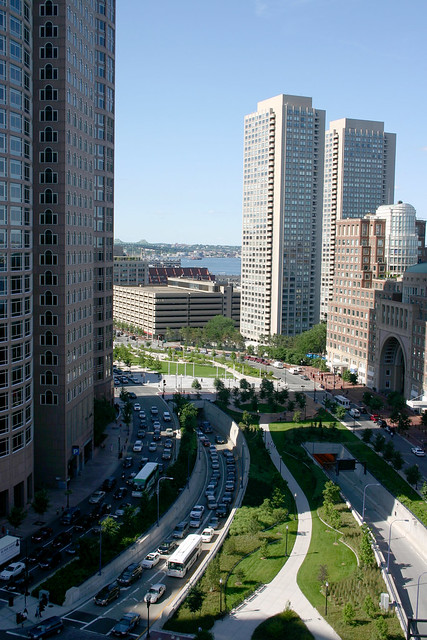 |
| Skyscrapers, open space, and highways (source) |
Many people do not want to have to think about issues of urban planning. They just want to get on with their lives and leave planning to the experts. But Jane Jacobs exposes the so-called experts as charlatans, with little useful knowledge, and a hideous history of malpractice behind them. Instead she implores readers to look for themselves, and "also listen, linger and think about what you see." As people, we live in cities, and are economically dependent upon cities. We cannot escape their importance, and so it behooves us to pay attention to their vitality.
Monday, January 30, 2012
Stupid wastes of money

Part 1 in this never-ending series:
The 57 bus travels from Watertown Yard through Brighton, Allston, and down Commonwealth Avenue until Kenmore Square. The penultimate stop on this route is at Blanford Street on Boston University's campus. It is also the site of the nicest bus stop on the route.
Not only does it have a new sign (showing the Stop ID number!) but it also gets a brand new shelter. This would all be wonderful except for the simple fact that the bus route terminates one block further, in Kenmore Square. In the past, this stop used to be listed as "drop-off only" but that disappeared at some point. Why did the MBTA have a bus shelter built here, instead of at heavily used stops such as Harvard Avenue or Packard's Corner? How did such a waste come about?
About the only reasonable explanation I can come up with is that this might be used as a shuttle bus stop for the Green Line during substitute busing service. But that's a rare occurrence and they haven't shown the same consideration at other more popular stops nearby.
Saturday, January 28, 2012
The narrowest street in the South End
 |
| Ghost sign |
 |
| Something different |
I did end up finding a few more ghost signs, and I'm sure there's plenty of others too. I even spotted one of the "controversial" new street signs. But I ended up turning away from the broad arterial streets and poking around some of side roads. You have to be careful when walking around here. The red bricked sidewalks are quaint but bumpy. The neighborhood is fairly pleasant to walk around but the monotonous red brick gets tiresome after a while. I did stumble on some unexpected sights however. One person decided to cover their front entry with curious little statues. I hope they weren't harassed too badly for it by the neighborhood association around here.
 |
| Taylor Street |
Then nearby, I spotted a real outlier: a narrow street! Almost as narrow as the famous Acorn Street in Beacon Hill. Not too shabby. Shame that about half the length of the street is taken up by a park that isn't open to the public (currently, at least). I wonder how this street came to be. It's fairly close to Washington Street, so it is possibly one of the oldest in the area. There were a few more relatively narrow streets close by, as well, though they had at least one lane of street parking on them. Quite a few parks or playgrounds in the immediate vicinity, and they were pretty popular on this warm winter day.
 |
| The narrowest street in the South End! |
I walked back along Washington Street. I've been past here several times, but never noticed this particular view of the Hancock buildings. The parking lot makes a big contrast with the rest of the neighborhood, although it is sadly typical of Washington Street, which is strangely desolate in this part of town.
 |
| New and Old Hancock buildings from Washington Street |
Thursday, January 26, 2012
Improving the Green Line: Fare Collection
 |
| Coolidge Corner on the "C" line (source) |

 |
| Monthly pass-holders boarding the rear doors (source) |
The problem is that when people's emotions run high on an issue of "fairness" they neglect to consider such bloodless items as cost/benefits analysis. Seeking 100% enforcement of fares is insane and a negative value proposition in any realistic scenario. The proper way to do this is to choose fares, evasion penalties, and collection mechanisms to maximize expected value based upon practical experience, and to accept that no system is perfect. The marginal cost of a single fare evader is extremely low because the operational costs are fixed -- the trains are going to run regardless of whether that one person is riding it. If allowing the fare evader takes a car off the roads, that would be a net benefit. But almost none of this is ever considered when people get upset about fare evasion, and it turns into a political circus instead.
 |
| Waiting for the SF Muni N (Judah) in mixed-traffic (source) |
Advantages:
- Operator is not stressed by responsibility of collecting fares.
- All doors boarding -- much faster.
- Single operator per train is a major cost saving measure.
- Transfer system is simple and easy to understand.
- Easy to tweak: if fare evasion is too high, then increase patrols and/or increase fines. If fare evasion is low, then cut back and save money.
- Might be confusing to newbies (good signs are crucial).
- Requires occasional patrolling fare enforcement officer (already exists, though).
- Penalties must be stiff, which may be politically difficult.
- Relies on expected-value to recoup costs. The probability of getting caught may be low, but the fines should be set to recover that value. However, this tends to trigger a psychological backlash in the people who do get caught (the "why me?" effect).
One thing everyone agrees about: the "B" and "C" lines are too sluggish and must be improved operationally, somehow. Following the advice of "Organization before electronics before concrete" it seems that the simplest thing to do is to open all the doors at every station stop. Whether this would result in too much fare evasion is a matter of contention that unfortunately becomes more emotional than economic. But I believe that Proof-of-Payment is a mature and reasonable fare collection strategy that has significantly lower implementation costs than fare-gates, and is easily suitable for medium-traffic transit such as the Green Line.
Tuesday, January 24, 2012
Response from MBTA
I sent my comments by e-mail on January 5th. Today, I received this response:
Dear Matthew,
Thank you for your comments on the proposed fare and service changes for the MBTA. We have reviewed your comments regarding the proposed fare increases. In FY2013, the MBTA is facing a budget deficit of more than $161 million. To balance our budget, the MBTA has proposed a combination of fare and service changes. In crafting these changes, our goal has been to find the best solution for the most people.
The MBTA has not raised fares since 2007. In both of the proposed fare and service change scenarios, MBTA fares would remain below transit prices at other major US transit agencies such as New York, Chicago, and Washington, DC.
Your comments will be considered as we determine the final proposal for fare and service changes. We also welcome you to attend one of the more than 20 upcoming public meetings on fare and service changes. For meeting times, locations, and updates on proposed fare and service changes please visit mbta.com/jointhediscussion.
Sincerely,I wonder what took them so long to send out this obviously canned response. The biggest meeting was yesterday. Did they wait until now to open their mailbox?
Jonathan R. Davis
General Manager
Monday, January 23, 2012
Rally at MBTA Public Hearing
 |
| Rally in front of the State House |
I attended a rally today to protest the MBTA's plans to cut service and raise fares. This was organized by the Transit Rider's Union and Students Against T Cuts. There was a fairly diverse crowd of about 50 or so people at the rally, and several members of the media including Boston Globe online and a local TV news crew. They handed out some posters to carry and buttons to wear and led the crowd in several chants (admittedly, I had a hard time understanding some of what they were saying). This was followed by some short speeches from various organizers. A couple state representatives showed up to give their support as well. Then we headed into the Common and over to 10 Park Plaza for the 1pm public meeting.
 |
| Going to the MBTA public hearing at 10 Park Plaza |
First Deputy General Counsel Gerald Kelly explained that this was a Public Hearing and there would be no Q/A session as a result: it was to satisfy a particular Federal Transit Law, and all comments would simply become part of the public record to be reviewed later. He pointed out several individuals who would be conducting discussions and answering questions, outside the event. Then he introduced the first speaker, Josh Robin, Director of Innovation. I remember that I've spoken to Josh on a previous occasion, about adding the Stop ID to bus stop signs so that it was easier to use NextBus. He is also the guy behind the MBTA's twitter feed. This time, he was apparently supposed to give a PowerPoint presentation about the MBTA and its budget woes. He got a few slides in, talking about how the sales tax revenue did not meet expectations when he was interrupted by a lady up front. She protested that they were wasting time and they should move onto the public comment period, since there were so many people, and the slides weren't telling us anything new. There was a bit of an awkward moment as Josh attempted to continue giving his presentation, while the crowd sided with the lady. Eventually Gerald stepped in and opted to end the presentation and started the comment process.
One by one, people came up in order of their numbers and gave comments. There were many, some spoke too quietly, some too fast, but I attempted to record the gist of what they were saying. Here is what I heard, and I apologize for not getting people's names, it was hard to hear most of the time:
- E-line and Mattapan HSL are serving environmental justice communities and will be cut.
- The 39 bus has higher operating costs than the E line.
- Several seniors with disabilities from revere, living on SS check / fixed income, will be stranded with cuts
- A lady from The Fairmount Indigo line organization says 90,000 people live in that corridor, many transit dependent. Why cut service after building $160mil of station expansions? Also, zones make no sense - up by $4 to go to Hyde Park even though it's all within the borders of the city.
- Handicap accessibility is important, many route cuts affect hospital service.
- Arlmont Village will be cut off from transit.
- People can't get around, they don't have cars.
- Assembly Square losing almost all service, and still several years to go before subway station.
- The T never fixed a programming bug in the CharlieCard system with regard to bus-subway-bus transfers costing double, and that will be made even worse by changes. e.g. Traveling from Somerville to Southie.
- Dudley operations are mismanaged - buses pull in, park and leave riders out in the cold instead of leaving immediately or at least letting people board.
- Big Dig alleviates traffic for people who drive cars, why are transit riders paying for it? Commuter Rail cuts on weekends lead to more drunken driving. Ask drivers to pay for the Big Dig.
- Fellow was born in Boston, lived whole life here, never bought a car because of T. He asks: What about Bruins and Celtics games? Lots of people use North Station for those.
- Cost $1.5 billion to build Old Colony CR recently. Now cutting service? Kingston has empty parking lot on Wednesday afternoon - re-examine parking policy?
- Eastern Service Workers Association: T's debt because of Bechtel/Parsons-Brinckerhoff failures. The $2 billion price became $22 billion on Big Dig. Recover some [more] of the cost from B/PB.
- Seniors fares cannot be raised so much (100%). Not enough E line service currently - often cannot board as it is too crowded already.
- This is not a solution, it is another problem. If we were trying to destroy public transit, this is the way. Work with us, not against us. Marblehead is losing 3 of 4 routes.
- Someone says their rep from Somerville has a plan. [NB: Maybe Rep. Provost?]
- Sat/Sun E-line is packed on weekends, why cut it and replace with polluting 39 bus?
- Natick needs CR on nights and weekends. Sports fans driving will just lead to more cars on the roads. Green line needs to stop fare evaders.
- Unfair for Worcester, getting fare raised because of Big Dig. Meeting not listed on MassDOT calendar, was hard to get people from Worcester informed. Where is Rich Davey, why isn't he here?
- When she heard the RIDE increases from $2 to $12 she nearly fainted.
- Rep. Gloria Fox sent statement to be read: She cannot support this proposal to raise fares. Her district has some of the lowest subsidized, highest ridership routes but will be affected badly, and is in a disenfranchised section of Boston.
- This proposal shuts off Weymouth from transit.
- Legislature needs to provide funding including raising gasoline taxes, it's been 20 years. Losing $400 million a year due to lost value from inflation.
- PowerPoint is not a good educational device. $5 billion in debt on MBTA, $3 billion in interest. $2 billion is Big Dig related. Need transportation financial plan so benefits don't just go to bankers.
- Alienating lots of people by raising fares - lost ridership.
- Transportation for America: these scenarios are not acceptable. Scraping it out of the hide of riders is like asking Varitek to split the uprights [NB: Boston sports reference]. We need to talk to our elected officials. There are problems across the board.
- MassPIRG: these proposals are bad public policy. Reduction in ridership: 30% of bus riders lose out. Short term fixes won't help in the long term.
- Millions of people shaped lives around public transit. Sympathy votes don't win bills. Need pragmatic solutions. Real lack of creativity when it comes to cuts. [Shows schedule with penciled changes] Convert Rockport expresses to locals and eliminate 3 trains without losing service. Early Sat. morning trains are packed with service industry workers. Tourists ride Rockport on the weekends to see towns on the north shore. Many late night trains have drunk Celtics fans. Snow days see increased ridership, that makes it easier to clean roads.
- TransitOnTheLine blogger spoke about importance of transit. [See also http://twitter.com/transitmatters]
- MBTA Ridership Oversight Committee: It's asinine to build expansions and cut service.
- Orange Line falling apart. Stop fare jumpers.
- State can borrow cheaply. State of MA should deal with this.
- Liveable Streets Alliance: this is a backwards plan. Boston won't attract young people. Are there any state reps in the room? [NB: Nobody answered]
- This choice is like shooting ourselves in the head with a .38 vs a .25. We need debt forgiveness.
- Raise taxes on income and gas to pay for Big Dig debt.
- This plan won't work. We'll be here next year. May as well call it "Jan 3rd, MBTA Fare Increase Day."
I also tracked down Josh outside and asked him what he thought of the whole ordeal. He said that they must try to find some way to balance the budget within these constraints, and that these proposals would technically do the job. I asked him why they did not pursue the removal of the Big Dig debt, and he said it was out of scope for them at the T. At this point he had to leave, but I also asked if they were trying to get the public involved to do something about the Big Dig debt, but he didn't have anything to say about that except a shrug.In 2007, the TFC report found that $1.8 billion dollars in MBTA debt was due to the court-ordered Big Dig mitigation projects. They formally recommended that this debt - which is the responsibility of the Commonwealth - be taken off the MBTA's books and given back to the Commonwealth where it belongs. This action alone could save up to $120 million a year in debt service costs.The forward funding legislation in 2000 made predictions about revenue which turned out to be almost completely wrong, in addition to putting the Big Dig debt on the T. It is time to go back and fix forward funding first, before considering fare hikes and service cuts - and put the Big Dig debt back where it belongs.
Wednesday, January 18, 2012
Drinking and Parking
A local music venue and bar wants to increase capacity by about 150 people. They are located in the heart of one of the most densely populated and busy neighborhoods of Boston. Management from the business came to a community meeting to talk about their plans. After having a discussion about the changes they made to satisfy fire and building codes, an older gentleman posed the question: "But will there be enough parking?"
The response: "The vast majority of our customers don't drive to get here." And that settled it. But it is amazing to observe how people think about parking. Even in this part of town - dense, walking and transit-friendly - the discussion quickly shifts to parking. At a bar, of all places.
Perhaps we need a companion campaign: "Drinking spaces and Parking spaces - they don't mix!" Just don't hire me to write the slogan.
Subscribe to:
Posts (Atom)