 |
| Harvard and Comm |
 |
| Harvard Ave Station |
 |
| Harvard Ave |
 |
| Brighton Ave |
|
| Harvard and Comm |
|
| Harvard Ave Station |
|
| Harvard Ave |
|
| Brighton Ave |


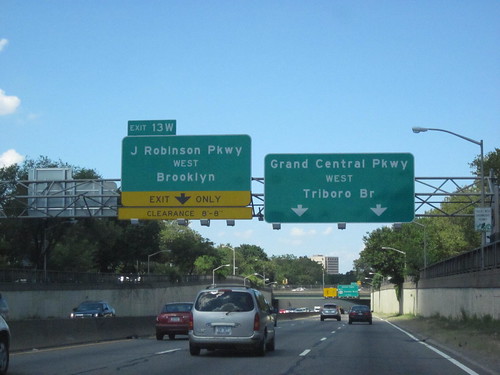 |
| Grand Central Parkway on a nice day (source) |
The Grand Central, Interborough, and Laurelton parkways opened early in the summer of 1936 [...] One editorial opined that the new parkways would, by relieving the traffic load on the Southern and Northern State parkways, solve the problem of access to Moses' Long Island parks "for generations."
The new parkways solved the problem for about three weeks. "It wasn't more than three weeks after they opened that I decided to go out to Jones Beach on a Sunday," Paul Windels recalls. "I got on the Interborough and by God it was as jammed as the Southern State ever was." Moses announced that he had the solution: build forty-five miles of new parkways [...]
Some city planners noticed that the traffic pattern on Long Island had fallen into a set pattern: every time a new parkway was built, it quickly became jammed with traffic, but the load on the old parkways was not significantly relieved. If this had been the pattern for the first hundred miles of parkways, they wondered, might it not be the pattern for the next forty-five as well? [p. 515]But when they suggested improved mass transit ideas that groups such as the Regional Plan Association had been proposing, they were ignored.
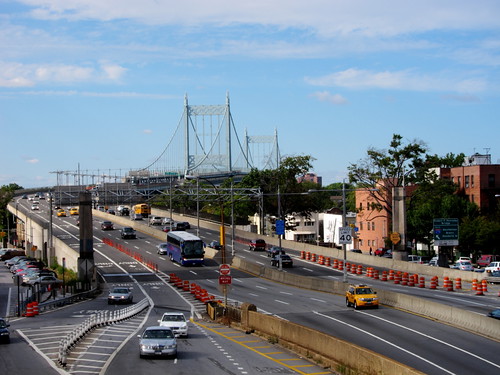 |
| The approach to one span of the Triborough (aka RFK) Bridge (source) |
The Triborough Bridge opened on July 11, 1936. [...]
On August 17, 1936, a little more than a month after the Triborough Bridge opened, Long Island's parkways were the scene of what some observers called the greatest traffic tie-up in the history of the metropolitan area.
Referring to it as a "cross-country traffic jam," the Herald Tribune was forced to conclude that the bridge had, at least indirectly, caused it. [...]
Despite the heavy volume on the Triborough Bridge, Othmar Ammann [the chief engineer] said, "the relief of the traffic load on the Queensborough Bridge has not been as great as expected." But the Times editors evidently did not consider this fact particularly noteworthy. [...]
Traffic between Long Island and New York had, before Triborough's opening, flooded the twenty-two lanes available on the four old bridges; suddenly the traffic between Long Island and New York had become so heavy that it was also flooding eight new lanes, the new lanes of the Triborough Bridge---and it was hardly any lighter than before on the old bridges. [p. 518]Again, Moses called for more parkways and what would become the Long Island Expressway. And again, the press went along with it.
The Wantagh State Parkway Extension was opened on December 17, 1938, three months ahead of schedule. [...]
[It] did not receive its first real test of traffic-easing capacity until the first warm weekend morning of 1939. On that morning, it was jammed bumper to bumper for more than three miles. Traffic experts could not understand where those cars had come from. The other Long Island parkways, after all, were just as jammed as ever. [p. 517]Having observed the problems, the RPA attempted to get provisions for a railroad link included on the proposed Bronx-Whitestone bridge. Moses refused to consider it.
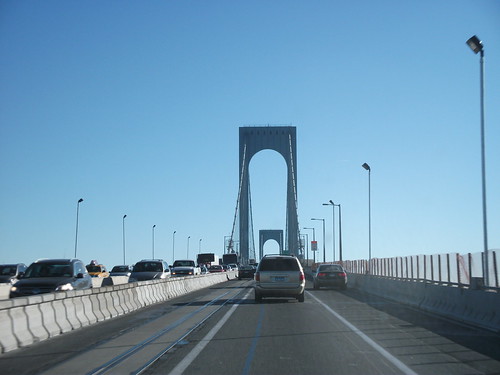 |
| The Bronx-Whitestone Bridge (source) |
During 1940, the first full year of operation, 6,317,489 vehicles passed through the Bronx-Whitestone's toll booths, cramming its four lanes to capacity and causing massive tie-ups on it. Traffic on the Triborough was reduced by 122,519 vehicles. Traffic on the other four East River bridges was reduced not at all. In fact, it rose slightly. Somehow the new bridge had generated, in a single year, more than 6,000,000 new on-and-off-Island motor trips. [...]
Shortly after the bridge opened, Moses completed the road linking the bridge with Westchester County, the Hutchinson River Parkway. Soon, that was jammed too. [p.519]At this point the book turns to the Gowanus Parkway, an elevated highway which ripped through the thriving Brooklyn neighborhood of Sunset Park, and destroyed the heart of it on Third Avenue. It replaced the elevated train line of Third Avenue which was supposed to be taken down in favor of the newly constructed Fourth Avenue subway. Instead it was replaced by a massive concrete elevated highway and the four lane avenue beneath was widened into a 10-lane road to carry the trucks which Moses would not allow on his "parkway."
The construction of the Gowanus Parkway, laying a concrete slab on top of lively, bustling Third Avenue, buried the avenue in shadow, and when the parkway was completed, the avenue was cast forever in darkness and gloom, and its bustle and life were forever gone. [...] Stores, restaurants and theaters had brought people to Third Avenue. Now half the stores, restaurants and theaters were gone.
The El had brought people through Third Avenue on their way to and from its stations. The parkway did not. Moreover, although the El had been a huge, gloomy structure, it was, as Cathy Wylde puts it, "one that people from the neighborhood relate to; they traveled on it, they were familiar with it." [...] "The highway was something different," Miss Wylde says. "It was noise, dirt, accidents, not lighted, a garbage dump, drag races along it in the night, wild kids, something totally negative. It was a tremendous psychological barrier. In a way you could say the people feared the highway." [...] Once the avenue had been a place for people; Robert Moses had made it into a place for cars. And as the avenue's roadway became more crowded, its sidewalks began to empty. [p. 523]
No sooner would Moses open the Brooklyn-Battery Tunnel at one end of the Gowanus Parkway and the Belt Parkway at the other than the Gowanus would be jammed solid with traffic. At rush hours, the traffic trying to get up onto it would be backed up solid, spilling off the ramps and back into the neighborhood for blocks. [p. 525]
Motorists pulling up to pay their tolls found themselves at the end of lines that seemed little, if any, shorter than the lines had been at the old Broadway bridge, whose congestion New York had considered intolerable. And there was another puzzling fact. Although the new bridge had been built to relieve the congestion on the old bridge, congestion on the old bridge had not been noticeably relieved. The lines of cars waiting to cross it were, in fact, almost as long as ever. [...]
The rush-hour jams were just as bad as the rush-hour jams had been on Riverside Drive before the West Side Improvement was built; reporters escorted over the West Side Improvement before it opened had found it reduced the time required for the nine-mile trip from sixty-eight minutes to twenty-six; now one of those reporters made the trip over the West Side Improvement at two rush hours---admittedly very bad ones---and found that on one trip it took fifty-eight minutes, on the other seventy-three. And looking at the situation that way, the total effect on traffic congestion of the West Side Improvement had been to move the congestion one block west---and yet there was still congestion on Riverside Drive, congestion that had been eased only slightly by the construction of a parallel route. [p. 563]
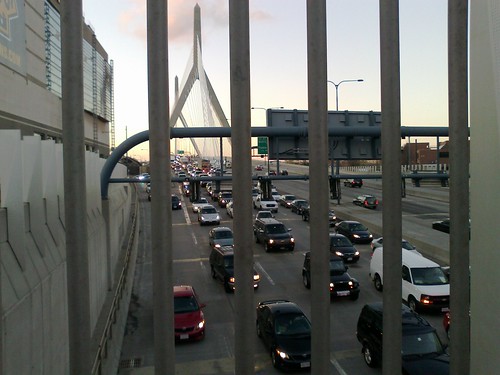 |
| The Zakim Bridge leading into the Central Artery/Tunnel |
Ultimately, many motorists going to and from the suburbs at peak rush hours are spending more time stuck in traffic, not less. The phenomenon is a result of a surge in drivers crowding onto highways - an ironic byproduct of the Big Dig's success in clearing away downtown traffic jams.
 |
| The Greenway boulevard atop the Central Artery/Tunnel |
 |
| Part of the Bowker Overpass |
 |
| Image from presentation (source): top-left is a map of parking asphalt vs parks in the vicinity |
 |
| Slide from presentation |


In Bowdoin-Geneva, a 68-block swath of Dorchester set between the rivers of traffic on Columbia Road and Dorchester Avenue, spring brings the usual signs of renewal. But it also brings something more sinister. It is a prelude to summer, which plays out year after year in this neighborhood against a backdrop of danger and a soundtrack of gunfire.
It is a problem that seems to simply never go away. The rate of shootings here over the last 25 years is four times what it is in the city as a whole — averaging 24 a year in the last decade.
[...]
No one seems to know exactly why. The drugs that spawned deadly territory fights two decades ago are no longer the primary fuel. Poverty, assumed by many to be a progenitor of violence, is much less severe than it was a generation ago and less prevalent than in some other Boston neighborhoods.
And there is this not-very-well-known fact: Gangs were in Bowdoin-Geneva long before the neighborhood became what it is today — at least as far back as the 1950s, when bands of white kids claimed street corners, wore identifying colors, and assigned themselves names.
They most often fought with their fists then, not with guns. But, as though a legacy handed to succeeding generations, gangs have remained even as the income, race, and social makeup of the neighborhood have changed. Bowdoin-Geneva now is an intricate architecture of alliances and loyalties based on little more than streets where boys and young men live. Slights real and perceived trigger violence between them.This behavioral description seems to be a tell-tale sign of lead poisoning, especially with its persistence across multiple generations and the socio-economic changes in the neighborhood. From the Washington Post article:
In 2002, Herbert Needleman, a psychiatrist at the University of Pittsburgh, compared lead levels of 194 adolescents arrested in Pittsburgh with lead levels of 146 high school adolescents: The arrested youths had lead levels that were four times higher.
"Impulsivity means you ignore the consequences of what you do," said Needleman, one of the country's foremost experts on lead poisoning, explaining why Nevin's theory is plausible. Lead decreases the ability to tell yourself, "If I do this, I will go to jail."
According to statistics from the city, the number of new lead poisoning cases declined from 1,300 in 2000 to 460 last year. The cases are mostly found in pockets of Dorchester, Roxbury, Mattapan, and Hyde Park. The highest concentration appears to be in neighborhoods in Dorchester's Bowdoin-Geneva Street area.In my unscientific opinion, lead poisoning is the prime suspect behind the troubles in this neighborhood. I would be interested to see the data that the city has apparently collected, and whether anyone is pursuing this topic more rigorously.
As the days lengthen and temperatures rise, the city too is looking to Bowdoin-Geneva. It has tried fitfully since the 1970s to find a cure for the troubles here. Now, after a spate of murders last year, the city is trying again, with a vow that this time it will make a lasting impact.If they want to fulfill that vow, instead of just repeating it every year, then I would recommend a heavy investment in lead abatement---much more than already exists---for this neighborhood. It will take money as well as time, and will probably not feel as satisfying as hiring more police officers. But all the available evidence seems to say that it will work, and more than pay for itself as an investment in the next generation.
It must have seemed like a great time to be young and a reformer in New York. In all American history, in fact, it would have been hard to find a better time. The young idealist entered public service in the very year in which there came to crest a movement---Progressivism---that was based [...] on an idealistic belief in man's capacity to better himself through the democratic process.
[...]
In searching for the causes of these problems [sweatshops, child labor, poverty of the slums], Progressives settled on the most easily identifiable---the giant corporations and corrupt political bosses who they felt had stolen mythical America away from its people. To exorcise these demons---to force a return to the political democracy and economic individualism that Americans were fond of believing had once existed in their country---they advocated reforms equally simplistic, so simplistic, in fact, that they proved primarily that the old American impulse to do good was still intact. And they were reforms that a young man who wanted to do good, a young man like Bob Moses, could advocate with all his heart.
Each job could be scientifically analyzed to show its "functions" and "responsibilities." Each function and responsibility---and there were dozens of them for most jobs---could be given a precise mathematical weight corresponding to its importance in the over-all job.
[...]
It was the proposal of a fanatic. John Calvin specifying permissible arrangements for women's hair in sixteenth-century Geneva was not more thorough than Bob Moses enumerating the "functions" and "responsibilities" of New York's civil servants. No aspect of conduct on the job was too small to be graded. Even personality must be reduced to number.
The net result of his work was nothing. [...] Convinced he was right, he had refused to soil the white suit of idealism with compromise. He had really believed that if his system was right---scientific, logical, fair---and if it got a hearing, the system would be adopted. In free and open encounter would not Truth prevail? And he had gotten the hearing. But Moses had failed in his calculations to give certain factors due weight. He had not sufficiently taken into account greed. He had not sufficiently taken into account self-interest. And, most of all, he had not sufficiently taken into account the need for power.
The lessons started almost immediately. When Moses submitted a preliminary outline of suggested commission goals, he included a phrase straight out of the reform textbooks and his Municipal Civil Service Commission days: "Elimination of unnecessary . . . personnel." Mrs. Moskowitz struck the phrase out. Personnel, she said, were voted. You didn't antagonize voters.It would take awhile, and although Moses would work on better reform proposals, they would have to wait because Smith lost re-election in 1920 and would not be re-elected until 1922. In the meantime, somehow, Moses became fast friends with Smith, a bond that would last until death. When Smith became Governor again, he brought Moses with him. And when Moses convinced Smith to focus on a parks program, Smith offered him the presidency of the planned Parks Commission.
a clause buried deep within the act empowered the Long Island State Park Commission to acquire land by condemnation and appropriation "in the manner provided by section fifty-nine of the conservation law."
[...] In 1924, "appropriation" had only one meaning in a legislative context: an allocation of funds by the Legislature.
[...] In 1884, the Legislature passed an act empowering the state to "appropriate" forest lands and defining "appropriation" as a procedure in which a state official could take possession of the land simply by walking on it and telling the owner he no longer owned it.In other words, he exploited multiple meanings of a legal term in a way that only the most savvy of legislators would detect. His friend Al Smith was likely the only one who would know. By writing this language into the bill he gave himself, in effect, almost unlimited power to take private property. That was not all: he made it virtually impossible to be removed as president of the Commission, to be audited by an outside party, or to be questioned by any of the subordinate departments he controlled.
Under Belle Moskowitz's tutelage, Bob Moses had changed from an uncompromising idealist to a man willing to deal with practical considerations; now the alteration had become more drastic. Under her tutelage, he had been learning the politicians' way; now he almost seemed to have joined their ranks.
More, he was openly scornful of men who hadn't, of men who still worried about the Truth when what counted was votes. He was openly scornful of reformers whose first concern was accuracy, who were willing to devote their lives to fighting for principle and who wanted to make that fight without compromise or surrender of any part of the ideals with which they had started it.
Bob Moses was scornful, in short, of what he had been.He created new parks, he restored old ones beautifully, he did a lot of nice things for the people of New York. But he also did a lot of terrible things to many individuals, and while he was happy to create amenities for "the people," he seemed to have a complete disregard for actual people---particularly minorities, the poor, or anyone who dared disagree with him.
"He doesn't love the people," [Frances Perkins] was to say. "It used to shock me because he was doing all these things for the welfare of the people . . . He'd denounce the common people terribly. To him they were lousy, dirty people, throwing bottles all over Jones Beach. `I'll get them! I'll teach them!' . . . He loves the public but not as people. The public is just the public. It's a great amorphous mass to him; it needs to be bathed, it needs to be aired, it needs recreation, but not for personal reasons---just to make it a better public."There's so much more---funny, sad and fascinating---and I'm only partway through the book myself. I'm definitely glad I picked it up.
"In every city throughout the country and in the sprawling suburbs surrounding the larger cities, traffic is piling up in swollen gasoline gullies, throttling industry, commerce and business; blocking street cleaning, fire and police apparatus; endangering the lives of men and women going to work, of mothers pushing baby carriages, and of children going to and from schools and playgrounds."
"Fully half of all traffic deaths are due to speed. Cars have become more dangerous than wars."
"The traffic accident cost to this nation is almost beyond belief."
"[Regarding railroad crossings at grade] It is the highway, not the railroad--the car, not the train--which creates the hazard and must be primarily responsible for its [the grade crossing] removal."It was a little unfair, as far as I can tell these quotes do not appear anywhere online except for the last one which appears verbatim in an FHWA manual for some reason.
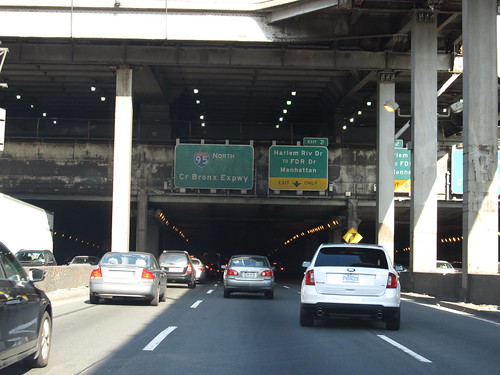 |
| Trans-Manhattan Expressway (source) |
"Parkways were designed, built and protected for pleasant, careful driving. Cross traffic has been eliminated by attractive stone-faced bridges. Wide rights-of-way have been landscaped with native trees, flowing shrubs and evergreens. They have been developed as shoe-string parks with pavements for passenger cars only. All this is a useless expenditure for the speeders, who, at the rate they travel, cannot distinguish a rosebush from a bale of hay."Can such a hardened political operator be so naïve as to think people would cruise slowly through isolated highways "just because" there was a bunch of pretty grass at the side? To be fair, it's not just Moses who thought this way, such parkways were popular all over, particularly in Boston. Of course, designers such as Olmsted at least had the fair excuse of being dead by the time speedy motorcars were prevalent. Sadly, a whole lot of urban parkland was turned into a stinking, congested, polluted car sewer by the time people thought better.
 |
| Cross Bronx Expressway (source) |
"1. More drastic regulation of speed without regard to unrealistic, theoretically designed limits and political pressure for higher limits.
2. Stopping the senseless advertising of high-speed motors as a basis of sales.
3. An unrelenting campaign to acquaint the public with the cause and effect of accidents and especially the terrible danger of excessive speed."So the roads would be designed and overbuilt for speed, but arbitrarily low limits should be enforced and politically backed. We know how well that "worked" out. And he seems to have favored government intrusion into cultural matters such as advertising, as if that would somehow deter Americans from wanting overpowered engines, if it could even pass constitutional muster (which I doubt).
"We need many additional regulations and restrictions governing the use of motor cars, not only to make them safer but to facilitate their movement and increase their usefulness to the community. Tighter zoning requirements would be enormously helpful. These cannot constitutionally be made retroactive, but they can be extended and enforced on new structure and the rebuilding of old ones, so as to require offstreet loading and unloading facilities and parking spaces for a reasonable number of cars on the premises."Well, we did get safer cars since 1956. But we also got the "tighter zoning requirements" and that has been an unmitigated disaster for cities, turning so many of them into poor simulacra of bland suburbia that people fled in masses for actual suburbia.
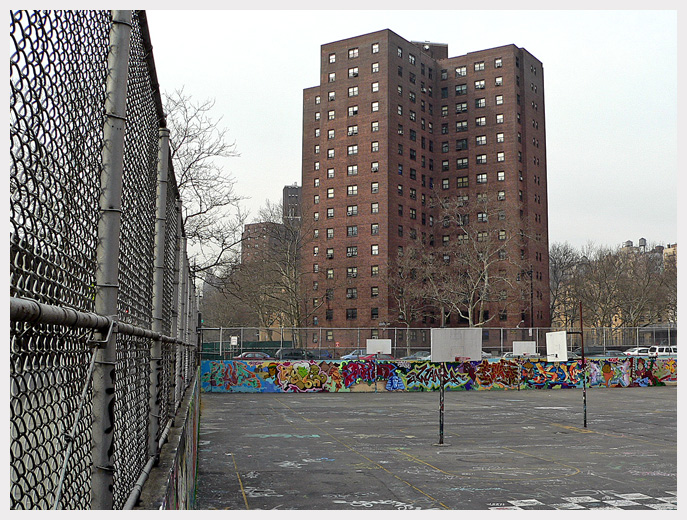 |
| G.W. Carver Houses in Spanish Harlem (source) |
"...demand that in city centers, including residential as well as business districts, all private cars be kept out, that we cut in half the present number of taxis, that no parking, even with meter regulations, be permitted, and that we abandon all tall buildings for low horizontal structures on large garden plots. Dull, worn-out officials and irresponsible planners join in such proposals. But the process of change must be evolutionary and in charge of those whose aim is to modernize not revolutionize, to preserve values, not destroy them."I think we can safely agree that banning private cars, and tall buildings -- in favor of large garden plots with low buildings -- is a bad idea. But, oh, the chutzpah. This from the man who brought upon New York City the horrors of the superblock, tower-in-the-park style housing project. A city which, I might add, was in no danger of losing its tall buildings or cars. And finally, that he thought of himself as evolutionary, that he was preserving rather than destroying? To address that I'll add one final quote from Robert Caro, my favorite one so far, although there is plenty more to review (italics original):
 |
| Webster Ave in Tremont, as seen from the Cross Bronx (source) |
When he [Moses] replied to protests about the hardships caused by his road-building programs, he generally replied that succeeding generations would be grateful. It was the end that counted, not the means. "You can't make an omelet without breaking eggs." Once, in a speech, he said:
"You can draw any kind of picture you like on a clean slate and indulge your every whim in the wilderness in laying out a New Delhi, Canberra or Brasília, but when you operate in an overbuilt metropolis, you have to hack your way with a meat ax."
The metaphor, like most Moses metaphors, was vivid. But it was incomplete. It expressed his philosophy, but it was not philosophy but feelings that dictated Moses' actions. He didn't just feel that he had to swing a meat ax. He loved to swing it.Some preservationist he was.


