Pages

Tuesday, March 10, 2015

The scourge of single-story retail

A curious pattern exists in Boston (I've also noticed it in other American cities). Neighborhoods that were primarily developed between 1890 and 1960 tend to have a lot of single-story retail. Oftentimes those retail shops are adjacent to multistory residential or office buildings, but the retail buildings themselves are single-story. Many of them are cheap boxes that look awful, while some of them do have decent architectural features that seem strangely out-of-place.

I'm sifting through some of my pre-snowpocalypse photographs for this post, so we can remember Boston as it once was.

The Fenway is a densely populated vibrant neighborhood with a strange dichotomy between retail buildings and residential buildings, like many other streetcar suburbs built around the same time.

Another example from the Fenway.

Double-whammy of bad 20th century planning: surface parking and single-story retail immediately adjacent to major Green Line station in Brighton.

Same place, across the street. Typical of Comm Ave, there's a strip of single-story retail adjacent to 5-story or more apartment buildings. Some parts of Comm Ave do have ground-floor retail below residential, but it's the exception, not the rule.

Union Square, Allston, with lots of great little shops and restaurants. But almost all of them are in single-story retail buildings. The tall building behind is from the 1980s, and does have a little bit of ground floor retail included, but is separate from most of the shops you see.

Single story retail from the early 20th century. But as you can see, it used to be a whole lot better. Nowadays the building is used for storage of automotive supplies, and the intersection is a motor vehicle-dominated nightmare. In 1889, the first electric trolley line in Boston departed from the Allston depot along those tracks. Now, the Allston depot is a pizzeria with a giant surface parking lot.
In the mid-1960s this theater was torn down to be replaced by a nearly featureless single-story retail building with surface parking out front. As the zoning regulations of the time would dictate.

Single-story retail in the center of Hyde Park's business district.
Single-story retail in triple-decker Dorchester, along Blue Hill Ave, where trolleys once roamed, and where frequent buses ply today.
Single-story retail and massive surface parking near Forest Hills, a major MBTA subway, bus and commuter rail station.
Single-story retail on Comm Ave next to a Green Line station.
Tall residential, short retail, MBTA station: Brookline is no exception.

In a city with an acute housing shortage, where space is at a premium, why do we allow so much waste to take place? It seems like there are hundreds of thousands of people who would like to be able to live in these neighborhoods with decent local shops, and in some cases, places that are only steps away from frequent MBTA service. Multistory buildings with ground floor shops and upstairs residences are not new in Boston -- they were quite commonly built in the 18th and most of the 19th centuries. The oldest neighborhoods in Boston: Beacon Hill, the North End, even the Back Bay, all have streets lined with buildings that have ground floor retail and homes above. Yet, starting around 1890 or so, it seems, some kind of insanity gripped America: suddenly, neighborhoods started being developed with apartment buildings on one block and single-story retail on another. Sometimes even on the same block.

I don't have a definitive answer, but there are several pieces in play:
  • The criminally incompetent, so-called "City Planning" movement started around the turn of the 20th century, and these new planners were notoriously blind to the actual sources of city vitality and diversity. In some cases, they were opposed to city life, and actively sought to destroy it. Records from the City Planning Board of Boston show that many early discussions focused around choosing which buildings to destroy in order to widen roads. No doubt, they probably saw mixed uses as being "messy" and falsely perceived them as a source of traffic congestion.
  • Property tax laws in this country can be counterproductive: they effectively penalize landowners who invest in their properties. In some cases, building owners may have chosen to cut down floors off their own buildings to save on tax expenses. In a sane world, such crazy outcomes would result in legislative self-examination and reform of the tax laws: for example, by repealing property taxes and replacing them with something less harmful like a land-value tax. In this world, well... no.
  • In New England (and NY) it was common to quickly erect buildings that became known as "taxpayers" in order to generate some value quickly for the land without much effort. These taxpayer buildings were just enough to house some retail and then got locked into place when zoning came into effect around the mid-1950s. Many of the featureless boxes plaguing our landscape seem to fall into this category, but there are also plenty of examples of single-story retail with the kind of fine architectural detailing that seems out-of-place on a taxpayer.
  • The economics of redevelopment seem to require a significant density boost in order to replace a revenue-generating property with a new one. If floors cannot simply be added to the top of the single-story building, and if the construction requires a shutdown of the business operating within, then the end result of construction has to be much taller than what previously existed. In the case of single-story successful retail, that probably means going up to 4-6 levels.
  • And this discussion wouldn't be complete without mentioning the nefarious effect of mid-20th century zoning regulations. It is quite possible that many single-story retail buildings were intended to be temporary. But once zoning kicked in, redevelopment -- already difficult -- became near impossible. The density boost required to make redevelopment financially palatable was now illegal or required expensive variance hearings. In many cases, even the existing property was made illegal by unreasonable zoning requirements that demanded excessive amounts of parking that simply could not be provided in a space-constrained city neighborhood.
So, as a result, we have a bunch of neighborhoods where, if you somehow transported some people from 1915 one hundred years into the future to 2015, they might ask: "Why do you still have all these same crummy, single-story buildings that existed in my time?" ... After, of course, catching up on the past hundred years of history.

If we are serious about tackling the problem of rising housing costs and creating a better, more vibrant city that is accessible to all, then we will need to find a way to deal with these squat, inefficient, single-story structures. I often hear people complain that Boston is space-constrained, that we don't have room for development. That's not really true, as there are too many vacant parcels. But there are also many underutilized parcels in locations that can easily support much more. The replacement of single-story buildings that are located adjacent to frequent transit ought to be a high priority for all of the cities and towns in the region.

Friday, February 20, 2015

Snow daze

Spotted this while passing through -- first snow of the year and it's still fun for bicicle snow man
Blizzard returns streets to people
Best way of getting around now
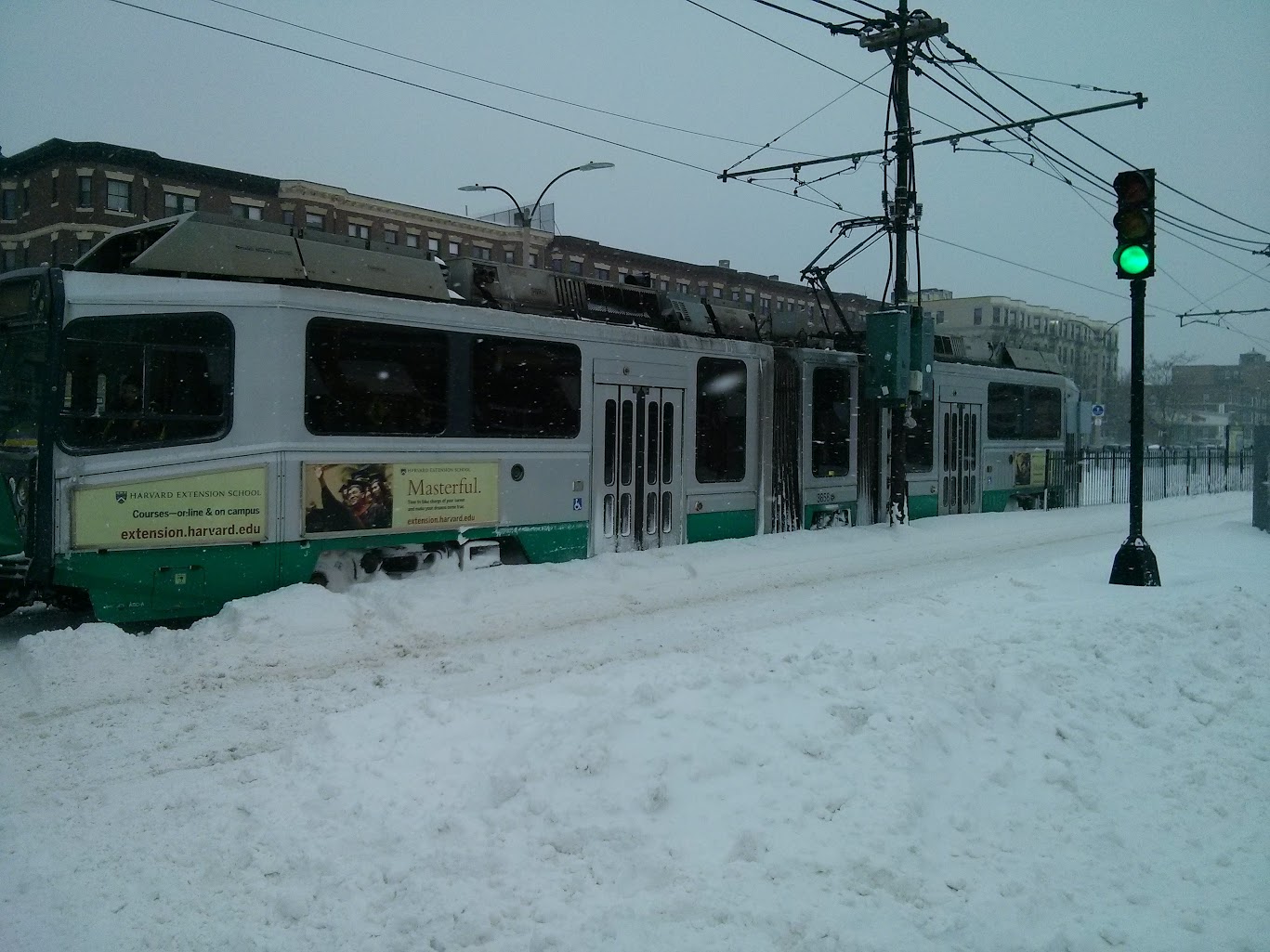
No revenue service, but trains clearing snow still need a second operator apparently!
A space taken by automobiles returned to the people for one day.

Headed for the hills
Second best way of getting around in the snow (after skiing)

Such a strong desire line @ Naples Rd that people climb mounds of snow to use it
Snow soccer in what is regularly a dangerous intersection
Walking is the dominant mode of transportation on Comm Ave
Even on the deteriorating highway overpass, with tiny sidewalks
Guess who the city doesn't care about!
I could not navigate this canyon
Not a flake on the ground for drivers, however!
The bus stop is starting to disappear beneath the mounds of snow
Beautiful nearly dry pavement for motorists -- slush for people walking.
Cambridge Street overpass of I-90 is even less friendly in a blizzard
Sidewalk's gone
All that remains of the Framingham line
That Kenmore Square crosswalk STILL hasn't been cleared out
Park your car on the sidewalk and avoid shoveling snow! City says: "No violation found" either.
Relics of civilization pasT
Ah screw it
The Green Line is canceled and now what?
Snow tracks
Free (illegal) parking deemed more important than transit
Let's build a mountain of snow on the tracks!
The mountain is moving faster than the Green Line: faster than zero
The 57 cannot handle the load even late at night
Naples Rd desire line strong as ever, no matter what
They're waiting for the shuttle bus that may never come

Tuesday, January 20, 2015

False pretexts: motorists only pretend to care about ambulances when doing so happens to be convenient

Two bits of news hit recently that may seem unrelated, at first: Lawmakers seek crackdown on highway protests:
Rep. Colleen Garry, a Democrat from Dracut, proposed making it a felony to block highways. She told the Lowell Sun she was furious about the Thursday morning protests that blocked two sections of the heavily traveled highway through Boston, one north of the city and one south.
"I'm just outraged that people would be that reckless," Garry said. "Everyone has a right to protest, but to do that kind of thing in a highway or a roadway?" [...]
Nearly 30 protesters were arrested and arraigned on charges including trespassing, disorderly conduct, resisting arrest and willfully obstructing an emergency vehicle.

State police said an ambulance transporting a seriously injured car crash victim to a Boston hospital was forced to divert to a hospital outside the city that did not have a trauma unit. The man survived.
 
State Sen. Richard Ross, a Wrentham Republican, filed legislation that would impose a minimum $5,000 fine and allow a jail sentence of up to six months for willfully trespassing on state highways. Current law allows for a maximum $50 fine and a jail term of no more than three months.
And the same week, State to propose opening S. Boston Bypass Road to all drivers:
State transportation officials will file a notice in February with Massachusetts environmental regulators to allow cars coming into South Boston to use the Bypass Road, which is currently restricted to trucks and other commercial vehicles. The pilot program would last six months and could begin as soon as March. [...] 
The 1.1-mile road was built to accommodate trucks during the construction of the Central Artery, and when the tunnels were done, the road remained restricted. But as traffic becomes heavier in the fast-growing Seaport District, there has been pressure to open up the road to everyone. [...]
As part of its filing, the state will also propose letting all drivers use the high-occupancy vehicle lanes outside of South Station and the South End.
These two pieces of news are, in fact, related: because together they illustrate the hypocrisy and insincerity of our Commonwealth's transportation policy with regard to emergency vehicles. If our elected officials truly cared about emergency vehicle response time -- which they should -- then they would put a quick end to this proposal that will destroy the efficacy of both the South Boston Bypass Road as well as the HOV lanes outside of the South End. If not, then it is quite clear that these politicians, Rick Ross and Colleen Garry, are merely posturing and mouthing platitudes, all while silently sticking it to emergency responders. By far the most common obstacle for emergency vehicles on our roads is not protesters: on a daily basis, emergency vehicles are obstructed by other motorists and the traffic jams created by motor vehicles.


First, a little background: it is quite common for ordinary motorists to believe that the exact same facilities that enable their own travel at high speeds are also beneficial to emergency vehicles. A related objection to certain traffic-calming measures is that they will slow emergency response. However, in reality, the truth is much more complex and requires context-specific analysis. More car capacity might help emergency vehicle response time, under some circumstances. In other scenarios, additional car capacity might harm emergency vehicle response time. An additional, open, free-flowing lane can help emergency vehicles -- but if that same lane jams up with private automobiles then that lane just becomes an obstacle: an overall detriment to response times. In that scenario, removal of a jammed travel lane -- a reduction in car capacity -- can give emergency vehicles the maneuvering room they need in order to avoid the obstacle created by other motorists.

BU Bridge under renovation (source)
The BU Bridge renovation project gives a prime example of how removal of a lane can help emergency vehicles. The engineers behind this project understood that the prior existing condition of having four substandard travel lanes (with no shoulders) was unsafe and liable to create immovable jams at a crucial choke-point for emergency vehicles traveling between Boston and Cambridge. Therefore, they chose to eliminate a lane and reallocated its space into a pair of 5-foot shoulders on either side of the motorway. These shoulders are not intended for motor vehicle travel but they do provide a space for other vehicles to pull over while yielding to an emergency vehicle. In addition, they provide breakdown space to help recover from crashes or other incidents. They also serve as a continuation of the bike lanes coming from Boston. All-in-all, a fairly solid engineering compromise, considering that the intersections on both sides of the river need substantial renovation and rethinking.

But none of those safety issues were important to motorists such as Stanley Spiegel, who was quoted in the Boston Globe, in February of 2009, making this threat:
"There's going to be road rage," predicted Stanley Spiegel, who lives across the bridge in Brookline. "If you're going to spend public money to go for an improvement, you don't predictably make things worse.
This kind of attitude shows zero concern for the safety of anyone else, but it is sadly all too common among entitled motorists of Mr. Spiegel's ilk. Whenever safety or emergency response goals conflict with increased car capacity, we can see quite clearly where motorists like him stand. Thankfully, in the case of the BU Bridge thus far, MassDOT has not capitulated to the bullies who would remove the shoulder space and turn it back into a fourth congested travel lane.

The South Boston Bypass Road (source)
The South Boston Bypass Road was assembled out of a narrow right-of-way for the purpose of helping the industries along the waterfront thrive during the Big Dig. It also keeps a bunch of heavy trucks off of the regular city streets, and it provides a clear lane of travel for emergency vehicles operating between the South Boston Waterfront and South Bay. As you can see from this picture, the shoulders are fairly small: they seem to vary from 2-4 feet. It's not a road designed for high volumes of traveling vehicles. As a result, heavy traffic induced on this road could result in jam-ups that would be impassable for emergency vehicles.

For a number of years, pundits such as Shirley Leung have been campaigning to allow private cars on it. She has quoted old-school 'highwaymen', such as Frank DePaola (who coincidentally is the interim Secretary of Transportation right now), with statements like this: "If you have traffic, and you want to relieve it, you have to find road capacity." As a result of this kind of short-sighted thinking, the South Boston Bypass Road will be jammed up with private cars and will not be able to serve its former purposes any longer. And it goes to show, that when the political push comes to shove, concerns about emergency vehicles suddenly disappear, in favor of a temporary band-aid covering up much deeper, systemic problems with South Boston transportation.

HOV lanes are also a popular target of attack by privileged motorists. It's so common that it's even got a name: the "Empty Lanes Attack", so called because drivers will often claim that the HOV lanes are "mostly empty" or not being used, and therefore should be given over to single-occupancy vehicles. What they (intentionally) fail to realize is that the relative emptiness is what gives the HOV lane its value: it is passable. If it were congested, then it would not be useful. Too bad, then, that even our Boston MPO doesn't seem to understand that most basic of concepts. And because such lanes are designed not to be congested, they are also useful for emergency vehicles that need to bypass major traffic congestion. Thus, the proposal to 'open' the HOV lanes outside of South Station to general traffic will result in degradation of emergency response times.

Where is the outrage? Why, of course there is none: because motorists only pretend to care about ambulances when doing so happens to be convenient. The "Empty Lanes Attack" trumps their false concern about emergency vehicles: the allure of additional single-occupancy vehicle road capacity takes precedence over safety principles.


If officials really cared about emergency response times, then I-93 would have full-width shoulders and/or HOV facilities/zipper lanes extended all the way from end-to-end: taking existing lane space where necessary. It's the only responsible way. But, in fact, the current configuration of the highway that excludes such safety features from much of its length, especially where most constrained. This shows where the true priorities lie: always pushing for 8 lanes of general travel no matter what the consequences are to emergency vehicles or highway safety. Convenience for drivers of single-occupancy vehicles is more important than safety, to our decision-makers.

The fact is that it's easy for officials to claim that they care about emergency vehicle response times when doing so also means more capacity for drivers. But real courage would be shown by officials who show that they care about emergency response even when it's not politically convenient to do so. That means support for restricted lanes such as HOV or bus lanes. That means supporting safety features within the existing right-of-way of roads, without requiring costly expansion. And that means not playing these insincere political games in which 'concern' for safety only arises when it is useful for pursuing another agenda; when that same 'concern' suddenly vanishes the moment it is no longer useful.

Sunday, January 11, 2015

Taking a look at Green Line average speeds by hour of the day

Stairs can make boarding
be unnecessarily difficult
for some people.
With the real-time data available for the surface Green Line since mid-October, I thought I'd try some analysis with my gathered database. One thing we can look at is average speed of travel. Although the trains can ostensibly move at up to 25 mph in their dedicated lanes, or even faster off-street, they tend to spend a lot of time waiting at signaled intersections and station stops. In fact, the more passengers that are trying to use the system, the slower trains tend to go: overcrowding results in long dwell times as it becomes harder and harder for people to squeeze on and off the train. This effect is made worse whenever the MBTA forces everyone to use only the front door for boarding and alighting the train. The front door is small, and it has stairs, which makes the process take much longer as everyone has to slowly file in and out of the tiny opening.

The net result is that the Green Line can sometimes feel like it is traveling more slowly than if you walked. Well, perhaps that is hyperbole. However, it is possible to outrun a Green Line train on the "B" branch. A typical human runner, with some training, can sustain about 8-9 miles per hour. So we should expect to see average "B" branch speeds in a similar range.

The first thing we can do is consult the schedule by using a convenient mapping website to plot a trip from Boston College to Blandford Street at 8 o'clock in the morning. We find that the MBTA expects a "B" train to take about 27 minutes to cover the approximately 4 mile distance. That's about 8.9 miles per hour. Does that match up with the findings from the real-time data?

The following zoomable line chart is derived by calculating average speeds for the surface "B" branch during each hour of the day from 5 a.m. through 11 p.m., and breaking it down by week. So, for example, we can see that on the week of November 3rd, average speed at 8 a.m. was about 6.79 MPH and at 5 p.m. (hour 17) the average speed dropped to 6.61 MPH. That corresponds to an approximately 36 minute trip between Boston College and Blandford Street. Note that this chart does not distinguish one direction from another, so it is quite possible that the peak direction is much slower and the off-peak direction moves more quickly.


Plot of "B" branch average speed in MPH for the hours of the day from 5 am until 11 pm, looking at each week in November and December separately.


The weeks with the most rapid travel appear to be the final two weeks of December. This is not surprising. Much of the passenger load on the "B" branch comes from the universities, and those are on break during that time. Slightly surprising is the distant third-place finish for the week of Thanksgiving. Although the performance is better than the "normal" weeks, it is still rather low for a week when most students are traveling.
The "B" branch gets busy during the
off-peak hours as well.

In any case, the shape of the chart overall is telling. The two major valleys correspond to the traditional rush hours, when crowding on the Green Line grows extreme and dwell times increase accordingly. The most snappy performance is found either in the very early morning, or later in the evening. There seems to be a slight bump around 9 p.m. that might correspond to the late dinner and nightlife rush.

The difference between an average speed of 6.61 MPH and 10 MPH doesn't seem like much, but it is actually quite a bit: that's a difference of 12 minutes in end-to-end trip times. If the Green Line can manage an average speed of merely 10 MPH on a consistent basis, then a typical passenger can realize a savings of up to 12 minutes on their commute each way. That's pretty significant. Especially if you are able to increase reliability and cut out the variances that can sometimes lead to 15, 20 or more minute delays.

That's why I find prosaic improvements such as proper station spacing, transit signal priority, and all-door boarding to be vital. They don't have the same flashy pizzazz as building a new section of subway. But they can achieve much of the same benefit at a fraction of the cost.

Wednesday, December 17, 2014

Stupid idea of the month: pretending to solve pedestrian signal timing issues using Pong

 Game lets you play Pong with a person on other side of the crosswalk (source)
ThisIsColossal reports on "ActiWait", which is a video game with controllers on either side of a crosswalk, allowing two waiting pedestrians to play a game of Pong.
The ActiWait is a new generation of traffic light buttons. Installed at a pedestrian traffic light with long red phases, it offers pedestrians the possibility to convert boring waiting times into positive experiences. Through a touch screen which is installed in the upper shell of the button, people can interact with each other across the street.
As a public art project, it's neat. Especially while it retains novelty value. But as a "solution" to long red phases, it's incredibly stupid and condescending. Let's get this straight: is it okay to subject pedestrians to needlessly long wait times at traffic signals, so long as you give them a 1970s video game to play? Absurd. What's the message being sent here? As near as I can tell, the message is: "You walked? Well then, your time is worth less than that of a driver. Here, play a game, instead of getting where you're trying to go."

The solution to long waiting times is not games... the solution is shorter waiting times. Engineers should respect the fact that pedestrians are people too and they don't appreciate being forced to wait excessively long times simply for the convenience of motor vehicle drivers. This is not a difficult topic, and it demands no techno-wiz solution. The answer is simple: shorten traffic signal cycle times to reduce average waiting times. And don't require the use of "beg buttons" to cross the street. Pedestrians should be given at least as much respect as drivers. If you don't make drivers press buttons or play games at traffic lights, then you shouldn't force pedestrians do that either.

Slides from Ricardo Olea, SF MTA (source)
San Francisco is known for its pedestrian-friendly signal timing. As you can see, engineers at SF MTA understand that overall cycle length is very important to the pedestrian experience.

Doubling the cycle length causes the average delay for pedestrians to more than double. In San Francisco, a 60 second cycle length is fairly standard. Unfortunately, in Boston, most signal cycle lengths are between 90 and 120 seconds. Sometimes they vary depending upon time of day -- usually lengthening during rush hour. 110 seconds is a fairly common cycle length, in my experience. All of this is firmly in the "red" according to SF MTA, leading to unhappy pedestrians. Well, actually what happens is that Bostonians quickly learn to ignore the signals because the timing is quite obviously terrible.

ActiWait is from Germany so hopefully they will stay over there. Or perhaps they can invent a game that convinces traffic engineers to treat pedestrians better. Here's an idea: perhaps a little device that can be installed in their cars. At every single signaled intersection, it forces them to stop, push a button, and wait 50 seconds on average for a green light. The fun part is that if you push the button at the wrong time during the cycle, you may have to wait an extra cycle to go around before you get a chance to proceed. That's how signals in Boston are programmed. All the fun of a slot machine, and none of the reward!

Saturday, December 13, 2014

The SPOT app undermines the Clean Air Act, and therefore our air quality, in Boston

I recently read about the "SPOT app" that allows people to easily rent out an empty parking spot that they own and are not using. Sounds reasonable enough. I'm a fan of making more efficient use of physical resources. It's the opposite of "minimum parking quotas" that force everyone to waste huge amounts of land and money, and yet still fail to meet parking demands.

"SPOT app" (source: BostInno)

But, when I took a look at the map included with the article, it occurred to me that there is something not quite right about this. The app allows you to rent spaces in the Back Bay and downtown Boston. It transforms so-called "accessory spaces" that are attached to particular uses (such as residences) and allows them to be used instead as "commercial spaces" that are available to anyone, for a price.

So what's the big deal?

Well, back in the 1970s, the city of Boston was facing an air pollution problem caused by the creation of all those urban highways that tore through the city, bringing hundreds of thousands of cars spewing exhaust fumes into the air. In order to satisfy provisions of the Clean Air Act, the city of Boston agreed to cap the number of "commercial spaces" that would be available at any one time. It's called the "parking freeze" and it's intended to help preserve our air quality. The downtown Boston parking freeze cap is currently set at 35,556 spaces, and there is no capacity for new spaces at the moment. Yet, the SPOT app is effectively creating new commercial spaces that have not been subject to the parking freeze regulations. That means more cars, more air pollution, and more congestion.

I think it would be appropriate if the company that created the SPOT app were to be proactive about dealing with this air pollution problem. Perhaps they should disable the use of the app within the parking freeze zone until they figure out a way to mitigate the air pollution caused by the additional cars they may be attracting into downtown Boston. Perhaps it should only be available for electric vehicles within that zone. Or perhaps they need an allocation from the freeze "bank" in order to offer spaces in that zone. I don't know what the best solution is. But I do know that it is something that should be addressed. 

I'm also a little disappointed that City Councilor Frank Baker did not consider the implications for the parking freeze, the Clean Air Act, and our air quality, before providing an endorsement of the app.

One thing I did find really interesting is that the company behind this app has been collecting price information about short-term parking in various parts of Boston. This article has a breakdown. Average prices range from $1.75/hour in Allston/Brighton up to $3.75/hour in Back Bay. What's remarkable about these averages is that (a) they're higher than the city-wide set meter price of $1.25/hour, and (b) they're really not that expensive, and quite reasonable when compared with typical meter prices in other American cities. Even the Back Bay's average market-driven price of $3.75/hour is less than meter prices in busy parts of Vancouver, New York, Chicago, Los Angeles, and Seattle. Does it really make sense for places like the Back Bay and the South End to have city meter rates that are comparable to Boulder, CO or Rochester, NY (both $1.25/hour)? Hopefully, this inspires the city to give another look at using smart parking reform to address parking issues, instead of hurting the residents of the city with onerous minimum parking quotas. Those quotas are especially harsh on people who don't even own automobiles and yet are still forced to pay the cost to park other people's cars.

Monday, December 1, 2014

Thoughts on Question 1 and transportation funding in general

It's been a few weeks since the November elections, so I'm chiming in a bit late, but there's no real hurry. There weren't really any surprises with the state-wide office elections, and I don't know how that will all shake out in the new year when the new officials take office. But the success of Question 1 was a bit of a surprise to me. Part of that is the almost complete unreliability of polling on such questions. But also because Question 1 was so obviously a "Tea Party temper tantrum" that I figured Massachusetts voters would see through it.

In the past year, the legislature had finally taken some responsibility for transportation funding -- after twenty years of denial. They raised the gasoline excise tax by 3 cents, not enough to make up for the value lost through inflation, but something. And more importantly, they arranged an "indexing mechanism" that would ensure that we would not suffer through another twenty year period of fiscal farce. The "indexing mechanism" would keep the value of the excise tax steady over the years, ensuring that the regular effect of inflation would not become a source of de facto tax cuts.

Question 1 repealed the "indexing mechanism", thereby spurning the fiscally responsible step taken by the state legislature. Therefore, the gasoline tax will, in effect, receive an automatic tax cut every year going forward, again. Voters here have rejected irresponsible tax cuts in the past, so it's a bit of a head-scratcher, but hopefully not a trend-setter. In any case, if you are ever in conversation with a voter who claims to be "fiscally responsible" ask them if they voted for Question 1: if so, you can safely call them a hypocrite.

So what happens now? Well, the legislature is going to have to scramble a bit to find funding for some things. There are still plenty of failing bridges, potholes aren't going away, the T has 45-year-old subway cars that can't go without replacement, and buses have to be replaced on a regular schedule. It appears that the latter two are not in danger, and neither is the important Green Line Extension project through Somerville. But funding for everything else is questionable. That includes part of the cost of the Allston Interchange project that will replace the failing riverfront viaduct of the Mass Pike and reshape the area, fixing many of the problems that the existing highway afflicts on the neighborhood. There's the River Street and Western Ave bridges, which are crumbling. And several hundred other overpass and bridge repair or replacement projects that I could scarcely begin to enumerate. Roads ain't free, despite the feverishly held beliefs of the mostly suburban, mostly automobile-dependent voters who forced Question 1 on us.

Meanwhile, MBTA bus and train fares are virtually guaranteed to go up by about 5% every two years. Somehow, once again, public transit riders have been left holding the short straw, while drivers continue to reap steadily increasing subsidies in the form of inflation-driven gas tax cuts. Funny how that always seems to happen.

Paul McMorrow has suggested that we should adopt the idea of regionally-based taxes to pay for transportation projects. Ballot questions enacting regional sales or payroll taxes are popular in many western states. But it's not constitutional in Massachusetts, so this would require some fancy footwork or a change. And there's a bigger problem: we will end up with a system where transit projects are funded via additional regional taxes, while highway builders get to keep helping themselves from the general fund. Not a good dynamic. If Boston is forced to tax itself just to keep the MBTA running, then why should Boston subsidize highways in central and western Massachusetts? Either all transportation projects should be considered regionally, or none at all -- because we're all in this together.

For a few ideas to consider, check out the report last month from the Urban Institute about how the various states are handling the gas tax. Some have indexed the price in various ways to the going wholesale price of gasoline, which is one way to simulate a percentage-based tax like sales taxes. Oregon and Virginia are piloting a major reform that replaces gas taxes with vehicle-miles-traveled taxes. This is thought to better represent the cost to society of operating a vehicle on the public ways. The Federal government has also floated the idea of allowing tolling to be used on interstate highways (where it was not grandfathered). Tolling would be a fair way to obtain funding for highways, the counterpart of paying a fare to ride a train or bus. Used properly, it would also have the benefit of actually reducing congestion: with automated electronic tolling it's hassle-free, and part of the proceeds can be used to fund really good public transportation for people who don't or can't drive.

Here's a reform package I've been thinking about:

  • Apply sales tax to gasoline. Right now, gas is exempt from the sales tax, which is a hugely regressive subsidy to drivers at the expense of lower-income families. If we were to instead apply the sales tax to gasoline, then the overall rate could be lowered, so that other goods and products that everyone buys would not be subsidizing gasoline (at least, not as much). This could be designed in such a way that any increase in cost for gasoline would be made up for by decreased cost in everything else.
  • Change the purpose of the gasoline excise tax: instead of funding transportation, an excise tax on gasoline should fund clean-up of the pollution caused by gasoline usage, and also public health efforts to mitigate the damage to human health caused by gasoline usage. The rate of the gas tax would be set at the level needed to achieve these public health goals, which include the Healthy Transportation Directive and the Mode Shift Goal.
  • Other excise taxes should go into the general fund.
  • Transportation should be funded out of the general fund based on the merits and cost-effectiveness of each project in question. Such projects should have to compete with other worthy projects in other departments, such as schools, housing assistance, health care, and yes, even tax cuts.
  • Ridiculously bad boondoggles such as South Coast Rail, which is expected to cost the state over $500,000 per projected rider, should be discarded until somebody finds a way to get the costs under control.
  • All congested highways should be outfitted with variable, automated, electronic tolling. The tolls would vary from free (when there is little demand) up to whatever amount is required to clear out congestion at that time of day. The precise formula would have to be carefully designed in order to avoid surprising people. The revenue from the tolls can be used in several ways, and there is a reasonable argument that some of it should be used to ease the regressive effect of the tolls. Part can go to boosting public transportation capacity and frequency along the corridor, making it a real, serious option for many more people. This has the nice side effect of bringing the benefit of the transportation infrastructure to the many people who cannot drive, for whatever reason. Another part can go towards income tax relief for the low-income users of the highway who still need to drive. The rest should go into the general fund.
  • End all parking subsidies. That includes the minimum parking quotas found poisoning most zoning codes. The authority to impose such quotas, which are an intrusion on private property rights, comes from enabling legislation in the General laws, so it should be possible to retract that authority at the state level. Minimum parking quotas waste land, destroy healthy environments, raise housing prices, and, in general, these kinds of subsidies help cause traffic congestion. It's hard to imagine a more self-destructive set of regulations.
Does this package have a chance of ever passing? I doubt it. There's too much powerful, vested interest in the status quo. As we saw with Question 1, people don't like it when you end their subsidies, even if they are really harmful, self-destructive subsidies that cost the rest of us dearly.

I'd be interested to hear other people's ideas about transportation funding reform.